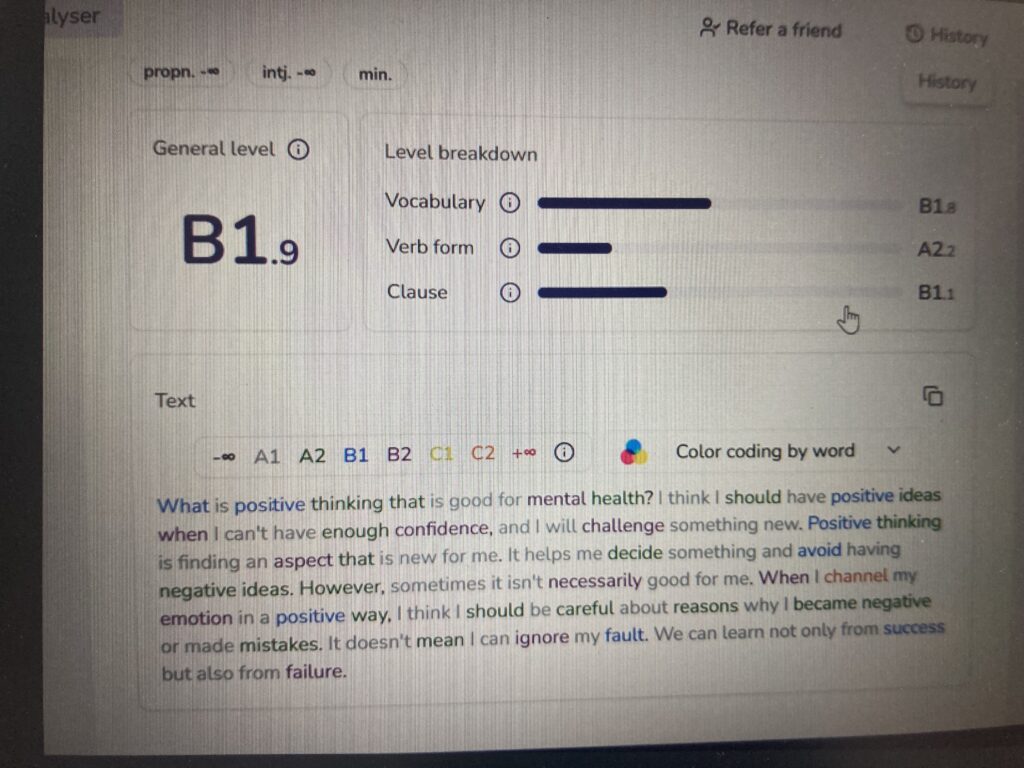
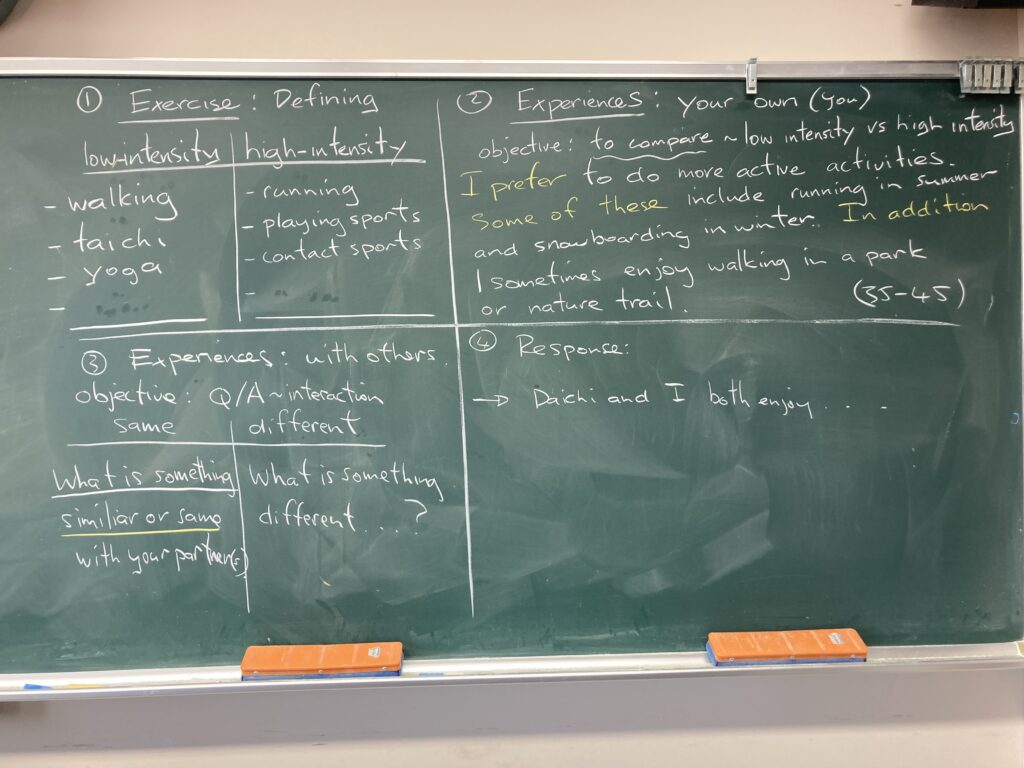
June 11 – Lesson 8

Task Title. Reading a Table: American standard

Task 1 Title Compare Cultures; a) Brazil / b) Japan

Task 2 Title: Japan Work Culture a) for / b) against

Task 3 Title: To change (person a) OR to not change (person b); please prepare your response

Task 4 Title: Graph Title

HOMEWORK

  • Quiz 7
  • Task 4: Find a Table (individual; not with your partner) about another culture topic (todays topic about Vacation). Including Japan and other countries. Write a short report (50-75 words). A4 paper! Take a screenshot of your Table.
  • Next lesson: show your table, and read your report to your group

For example:

  • retirement age
  • pension system
  • maternity leave (men or women)
  • salary / bonus system
  • income tax (salary tax)

Table 1

Optional / Support Activities

  1. The title of this Table is “Vacation Days per Year” per=every
  2. Short Description: reading left to right; 1) The left side has 8 countries, 2) From there there is information in order starting with Average =====employees give, next Average =====employee takes, and finally 3) Not used days.
  3. Detail (Line 1): In Brazil they have an average of 30days vacation (1), they take an average of 30 days (2), and there are no days left (3).
  4. Line (2-8): … write the details for every country.
  5. Results (the groups and details) (Task 4)

Task Activity: select countries and write the sentences

Task Activity Title: Evaluation: groups / grouping method

  • Step 1: decide the result – what is the result?
  • Step 2: what groups can you see – think about it?
  • Step 3: make the groups [***Hint – there are three groups of countries]

Teacher example:

  • In group 1 / For group 1 : there are no days vacation left. These countries include Brazil, Canada and France.
  • In group 2 / For group 2 : there are a few days vacation left. There are four countries and they are Malaysia, Mexico, UK and the US. The days left are between 1 to 4 days.
  • In group 3 / For group 3 : there are a lot of days vacation left. There is only one country Japan [ and they only take half the numbers of days vacation / and take 10 days only vacation ]

Lesson 8/9 – June 10/17

June 10th Aim: To read Tables and graphs

Task Title. Reading a Table: American standard

  1. The title of this Table is “Vacation Days per Year” per=every
  2. Short Description: reading left to right; 1) The left side has 8 countries, 2) From there there is information in order starting with Average =====employees give, next Average =====employee takes, and finally 3) Not used days.
  3. Detail (Line 1): In Brazil they have an average of 30days vacation (1), they take an average of 30 days (2), and there are no days left (3).
  4. Line (2-8): … write the details for every country.
  5. Results (the groups and details) (Task 4)

Task Activity: select countries and write the sentences

Task Activity Title: Evaluation: groups / grouping method

  • Step 1: decide the result – what is the result?
  • Step 2: what groups can you see – think about it?
  • Step 3: make the groups [***Hint – there are three groups of countries]

Teacher example:

  • In group 1 / For group 1 : there are no days vacation left. These countries include Brazil, Canada and France.
  • In group 2 / For group 2 : there are a few days vacation left. There are four countries and they are Malaysia, Mexico, UK and the US. The days left are between 1 to 4 days.
  • In group 3 / For group 3 : there are a lot of days vacation left. There is only one country Japan [ and they only take half the numbers of days vacation / and take 10 days only vacation ]
Task 5 Title Graph Report write a short report about the information for the 3 groups [try with no smartphone and pc]

Task 6 Title: Reflection What’s your impression about Japan’s data. Write what you think

HOMEWORK

  • Find a Table about another topic (todays topic about Vacation). Including Japan and other countries. Write a short report (50-75 words). A4 paper!
  • Next lesson: show your table, and read your report to your group
  • Quiz 7

JUNE 17

Task XTitle : Graphs

Activity: making sentences;

  • make sentences about the data
  • experiment with sentence patterns – by trying
  • listen and think about the pattern
  • which sentence do you like? what is the effect or expression
  • reverse method – grammar focus!
  • a method to re-word the data headings
  • a method to give an evaluation of the data – for example: The worst reason … / The number 1 reason… / The highest response …
  • give your opinion – for example: I was surprised that… /

Summary: Facts of Information (FOI)

  • we can use the internet to research for information and by using video / journals / newspapers / …
  • if we copy text/sentences from the internet we use “quotation marks” and we write the URL Heading/Title
  • Tables and Graphs also give a lot of information – reducing the information is helpful
  • we can write the sentences using a lot of grammar / methods
  • be clear and easy to understand (you do not need complex sentences!)
  • we can use numbers / % / describing words – half / all of them …

***remember to learn the key words (topic words) called vocabulary / phrases (short sentences) / grammar

Task 2 TitleReflection What’s your impression about Japan’s data. Write what you think about Japan’s work-culture / other themes – think about your group members HW and graphs (50 words). what is good / not good / … do you think it should change? Why? …

HOMEWORK

  • watch and learn the video (number 7) content *key vocabulary / phrases / main points link
  • Saturday quiz
  • Do not do the exercises on the video page!
  • next class; worksheet and homework upload June 6th/10th/17th

Lesson 6/7 – May 27/June3

Aim: To learn about culture “Customs & Traditions”

Task 1 Title: What culture do you like in Japan?

  • answer (a) : make a list
  • explain one (b) : 25-30 words

Task 2 Title: What customs are difficult for foreigners?

  • side (a) make a list with your partner (3to5)
  • side (b) teach one custom to a foreigner (30-40words): select a different custom than your partner

Task 3 Title: Supporting visitors in Japan

  • make a list with your partner – how can we : help / teach / show / support foreigners in Japan (a)

HOMEWORK May 27

  • video 6 part A: listening and taking notes of the video (campus paper / A4)
  • part b: reading the text
  • next quiz – Saturday 9am

Task 4 Title: Diversity – what does the video say about diversity (60-70 words)

Task 5 Title: Telling an experience (story) [ Techniques 18 ]

Task 6: Class activity see June 10 lesson

HOMEWORK June 3

  • Finish Task 4 (watch the video again) and Task 5
  • quiz 5 (Saturday 9am –>

7. Living in the future

Aim: To learn about what it is going to be like living in the future, and to express your opinions about the future

Method: Follow these steps. The teacher will give you a worksheet in class.

HOMEWORK: watch and learn the video topic and language

Class Activity

Step 1: Task 1: What is the definition of living in the future? Use the video to help you. Write your own words (20-25 words). Also write 15-20 key words (in English).

Step 2: Task 2: Listen to the video to learn about the topic. Think about the main points, how many main points are there? Write them.

Video

Step 3: Task 3: What is Hybrid Learning? Write your own explanation (20-25 words)

Step 4: Task 4: The main point “Redesigning work spaces” is a new concept for work. Explain this idea: (50words)

Step 5: Task 5: At 1:30 – “Office Study” is talked about. Explain what this study was about. (35words).

Step 6: Task 6: What are the challenges for the future? Explain them. Can you think of one challenge yourself?

Lesson 5/6 – May 19/26 Writing (EA) Task

E.A. – Writing

Aim 1: To write a a short paragraph about an Endangered Animal

Objective: To write a paragraph following a paragraph-writing format to give information.

Method: Research the internet about an endangered Animal. Follow the sentence structures below to write your short paragraph. There are seven sentences.

Procedure: Complete the sentences below

  1. Topic Sentence: Write a sentence to introduce your animal
  2. Main Point 1: Write a sentence to give information about this endangered animal
  3. Support Sentence 1: Give more details to explain the above point
  4. Main Point 2: Write a sentence to give information about this endangered animal
  5. Support Sentence 2: Give more details to explain the above point
  6. Opinion Sentence: Write your opinion
  7. Conclusion Sentence

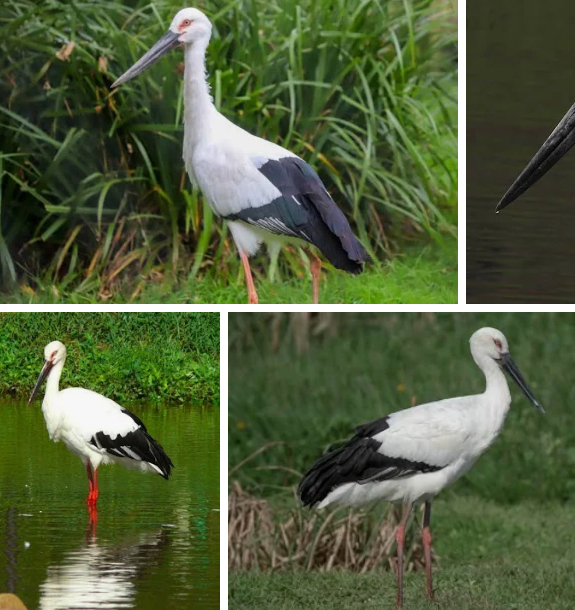
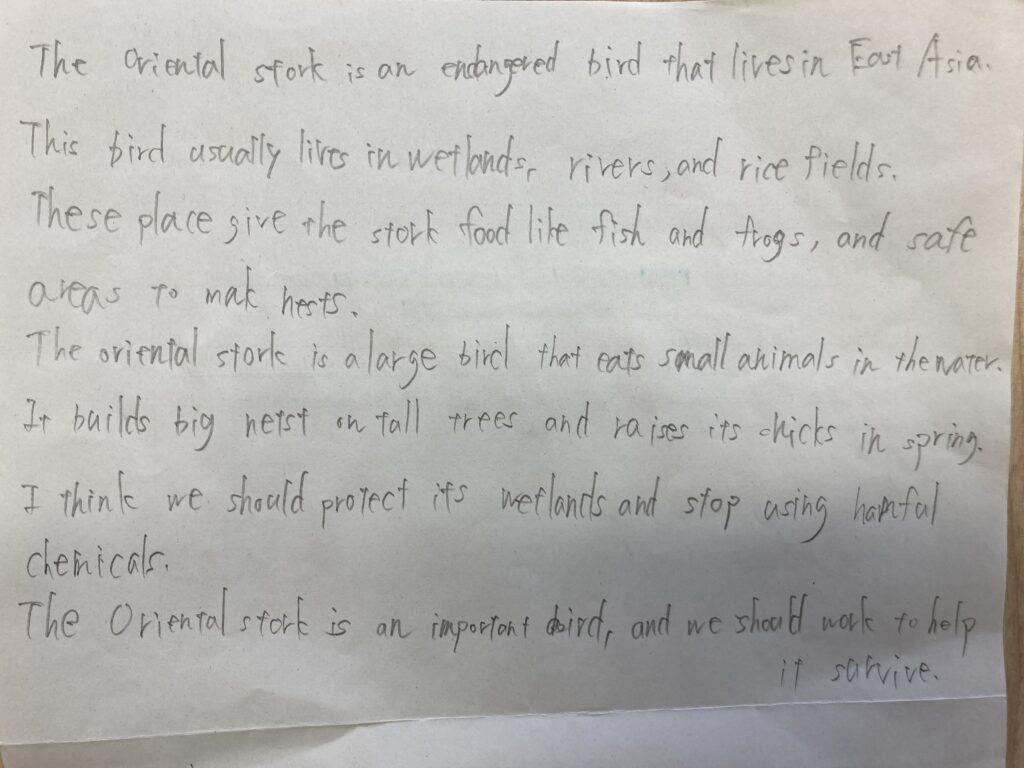
Student Example: Oriental Stork

Technique 15

Teacher Example: Numbat

1. The animal ‘Numbat’ is an Australian marsupial found in Western Australia.

2. There are only 2 different areas where you can find this animal.

3. There are also some human habitats for this animal.

4. This animal only eats termites and eats only during the day.

5. They sleep at night and live in a protected place, so they only eat in the day time.

6. I think that we should try to protect this animal from other animals at night.

7. The ‘Numbat’ is a cute looking animal and we should help to protect and breed this animal.

Homework Activity: 45 – 50 seconds

  • Read your writing (draft) and check your information
  • Check your video notes: Did you use any key words or grammar sentences? (target language – T/L)
  • Try and add some key words or T/L sentences
  • Read and check again
  • Finish for HomeWork – show me (teacher) in the next class

Activity: Conversation Practice – Technique (5)

click on the link

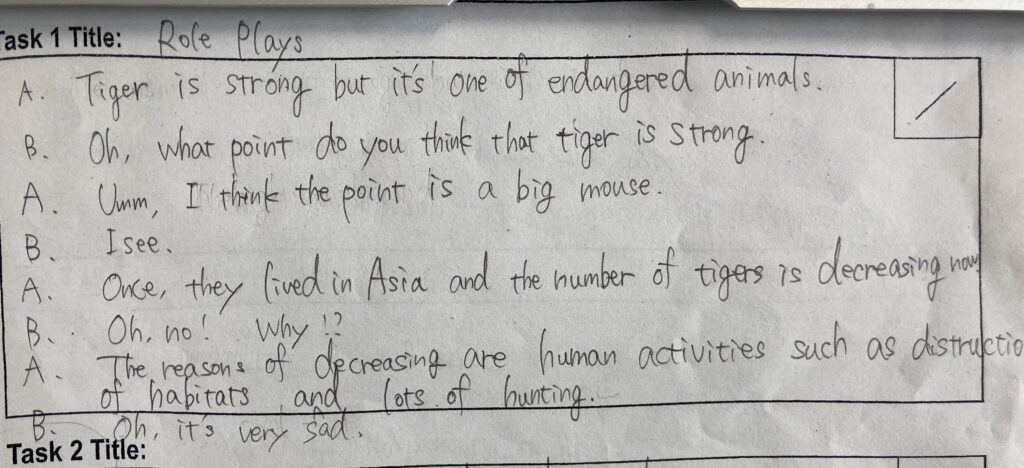
Activity: Task 1 Title: Role Plays

Aim: To make a conversation; take lines 1, 2 and 3 from your script (assignment)

Steps the teacher will guide you through the steps; Technique (3b) follow up questions link

Demonstration

  • A. The animal ‘Numbat’ is an Australian marsupial found in Western Australia.
  • B. Ahah / Amm. What is a marsupial?
  • A. It’s the same meaning as mammal. It is “哺乳類” in Japanese.
  • B. I see.
  • A. There are only 2 different areas where you can find this animal.
  • B. Only two. That isn’t a lot of places.
  • A. Right.
  • A. There are also some human habitats for this animal. For example zoo’s and wildlife parks.
  • B. I see.

Homework May 26

  • finish Task 1 – speaking focus is on the information (FOI) Facts of Information [main points]
  • write your script (assignment) in Task 2
  • quiz 4
  • Next lesson is a RolePlay; worksheet upload; and a special activity

Task 3 Title: FOI – statistics (information with numerals) [統計 – Tokei]

For example: using percent %; rate of information = number with time

Steps: research the internet and ask a question? About your animal. 2 examples:

  • Polar Bear – 100% of Polar Bears live in Arctica
  • Forest elephant – forest elephants make up roughly 25% to 33% of all elephants in Africa
  • Green Macaw Parrot – this bird had dropped by over 50% in the last 10 years

Student Role Play example

  • A. Once, they lived in Asia and the number of tigers is decreasing now.
  • A [FOI]. For example, the population of tigers declined by roughly (95%) over the last 100 years.
  • B. Oh, no! Why!?

Task 4 Title: Role Play + FOI (re-write your role play and add the FOI;

  • after you rewrite your role play
  • make your groups
  • copy your role play to the speech card
  • highlight your key words [read; look up and speak]
  • practice with your partner
  • video record

HOMEWORK

  • Quiz 5
  • Video 6b. Culture: please watch and study; main points; english words; phrases – take notes on A4 paper/campus paper

Writing Task Template & Activities

Aim: To answer questions and write your responses

Method: To complete the worksheet

Task 1: Video

  • Watch the video 1 more time, and then
  • Write your impression “your opinion” about this video (30-40 words)

Task 2: Meaning

  • Write a definition of the title […] – what does this title mean?

Task 3: Explain

In the video the term […] is used:

  • What does […] mean? Write the meaning in your own words.

Task 4: Japan

On a scale of 1 to 5 ( 1 is the least and 5 is the highest):

  • Rate Japans level of […] (1 to 5), and explain your answer (50-60words); the teacher will give you a writing format

Task 5: Select a question to answer (example: Customs and Culture)

Q.1

Question 1: Do you think we should learn about other cultures in Primary, JHS, and High School? Explain your answer. (30 words)

Q.2

Question 2: Which country would you go to for a study abroad program in university? Why? (50words)

Lesson 4 – May 13 Well Being sections

Aim: To learn and understand the meaning of

  1. Physical Health: May 13th
  2. Mental Health
  3. Social Health

Procedure: Complete the activity below and follow these steps: the teacher will give you instruction:

HW: Watch the Well Being Video and complete the following exercise link

  1. Watch the introduction section (1)
  2. Watch the Physical Health section (2) [2:10]
  3. Take notes: learn the key words (vocabulary) / expressions (short sentences – phrases)
  4. Answer the question: write on the speech card (80-100 words)
  5. Include your own experiences and others (Activity 2-4 today)

Why is physical health important for university students?

Writing Activity Task 3 –>

E.A. – Writing

Aim 1: To write a a short paragraph about an Endangered Animal

Objective: To write a paragraph following a paragraph-writing format to give information.

Method: Research the internet about an endangered Animal. Follow the sentence structures below to write your short paragraph. There are seven sentences.

Procedure: Worksheet: Open a new word document and;

  • Write the title “My Endangered Animal: Animal-Name”
  • Save your document: MyEndangeredAnimalAnimal-Name.docx
  • Back up your document on USB
  • Complete the sentences below
  1. Topic Sentence: Write a sentence to introduce your animal
  2. Main Point 1: Write a sentence to give information about this endangered animal
  3. Support Sentence 1: Give more details to explain the above point
  4. Main Point 2: Write a sentence to give information about this endangered animal
  5. Support Sentence 2: Give more details to explain the above point
  6. Opinion Sentence: Write your opinion
  7. Conclusion Sentence

Teacher Example: Draft report

My Endangered Animal: Numbat

1. The animal ‘Numbat’ is an Australian marsupial found in Western Australia.

2. There are only 2 different areas where you can find this animal.

3. There are also some human habitats for this animal.

4. This animal only eats termites and eats only during the day.

5. They sleep at night and live in a protected place, so they only eat in the day time.

6. I think that we should try to protect this animal from other animals at night.

7. The ‘Numbat’ is a cute looking animal and we should help to protect and breed this animal.

Format Method for Writing:

Homework Activity:

  • Read your writing (draft) and check your information
  • Check your video notes: Did you use any key words or grammar sentences? (target language – T/L)
  • Try and add some key words or T/L sentences
  • Read and check again
  • Finish for HomeWork – show me (teacher) in the next class

Speech Preparation – Technique 16

***Homework Practice

Lesson 5/6/7: May 20/27 June 2 – E.A. Writing

Aim 1: To write a a short paragraph about an Endangered Animal

Objective: To write a paragraph following a paragraph-writing format to give information.

Method: Research the internet about an endangered Animal. Follow the sentence structures below to write your short paragraph. There are seven sentences.

Procedure: Open a new word document and; WORKSHEET

Using your worksheet;

  • Complete the sentences below
  1. Topic Sentence: Write a sentence to introduce your animal
  2. Main Point 1: Write a sentence to give information about this endangered animal
  3. Support Sentence 1: Give more details to explain the above point
  4. Main Point 2: Write a sentence to give information about this endangered animal
  5. Support Sentence 2: Give more details to explain the above point
  6. Opinion Sentence: Write your opinion
  7. Conclusion Sentence

Teacher Example: Draft report

My Endangered Animal: Numbat

1. The animal ‘Numbat’ is an Australian marsupial found in Western Australia.

2. There are only 2 different areas where you can find this animal.

3. There are also some human habitats for this animal.

4. This animal only eats termites and eats only during the day.

5. They sleep at night and live in a protected place, so they only eat in the day time.

6. I think that we should try to protect this animal from other animals at night.

7. The ‘Numbat’ is a cute looking animal and we should help to protect and breed this animal.

Format Method for Writing:

Homework Activity:

  • Read your writing (draft) and check your information
  • Check your video notes: Did you use any key words or grammar sentences? (target language – T/L)
  • Try and add some key words or T/L sentences
  • Read and check again
  • Finish for HomeWork – show me (teacher) in the next class

Aim 2: To prepare for your speaking exercise;

  • Check your speech – maximum two sentences for each task.
  • Highlight / underline your key words – important sentence words / topic words.
  • Count – how many keys words do you have? You need a minimum of 15.
  • Next copy your speech to the speech card

Technique 16: listen to the teachers instructions

Activity: Task 5 Title: Role Plays

Aim: To make a conversation; take lines 1, 2 and 3 from your script (assignment)

Steps the teacher will guide you through the steps; Technique (3b) follow up questions link

Demonstration

  • A. The animal ‘Numbat’ is an Australian marsupial found in Western Australia.
  • B. Ahah. What is a marsupial?
  • A. It’s the same meaning as mammal. It is “哺乳類” in Japanese.
  • B. I see.
  • A. There are only 2 different areas where you can find this animal.
  • B. Only two. That isn’t a lot of places.
  • A. Right.
  • A. There are also some human habitats for this animal. For example zoo’s and wildlife parks.
  • B. I see.