Task 4 Title: Work Culture – Brazil / Malaysia / Japan
The title of this Table is “Vacation Days per Year” per=every
Short Description: reading left to right; 1) The left side has 8 countries, 2) From there there is information in order starting with Average =====employees give, next Average =====employee takes, and finally 3) Not used days.
Detail (Line 1): In Brazil they have an average of 30days vacation (1), they take an average of 30 days (2), and there are no days left (3).
Task 5 Title: Why do Japan workers (employees) only take 50% or half of the vacation days.
write 5 points in your groups
Task 6 Title : Graphs
Summary: Facts of Information (FOI)
we can use the internet to research for information
if we copy from the internet we use “quotation marks” and we write the URL Title
Tables and Graphs also give a lot of information
we can write the sentences using a lot of grammar
we can use numbers / % / describing words – half / all of them …
we can learn the language using video / journals / newspapers / …
***remember to learn the key words (topic words) called vocabulary / phrases (short sentences) / grammar
Task 6 Title: Reflection What’s your impression about Japan’s data. Write what you think about Japan’s work-culture (50 words). what is good / not good / … do you think it should change? Why? …
HOMEWORK
Find a Table/Graph about another topic (todays topic about Vacation). Including Japan and other countries. Write a short report (50-75 words). A4 paper!
Next lesson: show your table, and read your report to your group
Task 1 Title Compare Cultures; a) Brazil / b) Japan
Task 2 Title: Japan Work Culture a) for / b) against
Task 3 Title: To change (person a) OR to not change (person b); please prepare your response
Task 4 Title: Graph Title
HOMEWORK
Quiz 7
Task 4: Find a Table (individual; not with your partner) about another culture topic (todays topic about Vacation). Including Japan and other countries. Write a short report (50-75 words). A4 paper! Take a screenshot of your Table.
Next lesson: show your table, and read your report to your group
For example:
retirement age
pension system
maternity leave (men or women)
salary / bonus system
income tax (salary tax)
Table 1
Optional / Support Activities
The title of this Table is “Vacation Days per Year” per=every
Short Description: reading left to right; 1) The left side has 8 countries, 2) From there there is information in order starting with Average =====employees give, next Average =====employee takes, and finally 3) Not used days.
Detail (Line 1): In Brazil they have an average of 30days vacation (1), they take an average of 30 days (2), and there are no days left (3).
Line (2-8): … write the details for every country.
Results (the groups and details) (Task 4)
Task Activity: select countries and write the sentences
Task Activity Title: Evaluation: groups / grouping method
Step 1: decide the result – what is the result?
Step 2: what groups can you see – think about it?
Step 3: make the groups [***Hint – there are three groups of countries]
Teacher example:
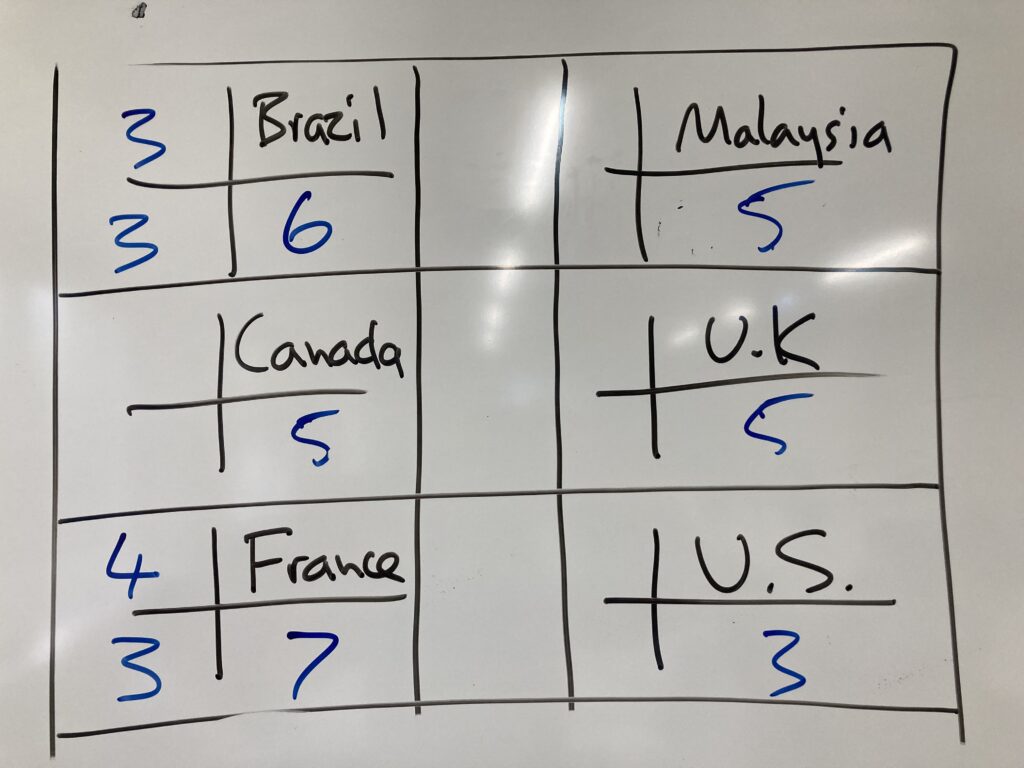
In group 1 / For group 1 : there are no days vacation left. These countries include Brazil, Canada and France.
In group 2 / For group 2 : there are a few days vacation left. There are four countries and they are Malaysia, Mexico, UK and the US. The days left are between 1 to 4 days.
In group 3 / For group 3 : there are a lot of days vacation left. There is only one country Japan [ and they only take half the numbers of days vacation / and take 10 days only vacation ]
The title of this Table is “Vacation Days per Year” per=every
Short Description: reading left to right; 1) The left side has 8 countries, 2) From there there is information in order starting with Average =====employees give, next Average =====employee takes, and finally 3) Not used days.
Detail (Line 1): In Brazil they have an average of 30days vacation (1), they take an average of 30 days (2), and there are no days left (3).
Line (2-8): … write the details for every country.
Results (the groups and details) (Task 4)
Task Activity: select countries and write the sentences
Task Activity Title: Evaluation: groups / grouping method
Step 1: decide the result – what is the result?
Step 2: what groups can you see – think about it?
Step 3: make the groups [***Hint – there are three groups of countries]
Teacher example:
In group 1 / For group 1 : there are no days vacation left. These countries include Brazil, Canada and France.
In group 2 / For group 2 : there are a few days vacation left. There are four countries and they are Malaysia, Mexico, UK and the US. The days left are between 1 to 4 days.
In group 3 / For group 3 : there are a lot of days vacation left. There is only one country Japan [ and they only take half the numbers of days vacation / and take 10 days only vacation ]
Task 5 Title Graph Report write a short report about the information for the 3 groups [try with no smartphone and pc]
Task 6 Title: Reflection What’s your impression about Japan’s data. Write what you think
HOMEWORK
Find a Table about another topic (todays topic about Vacation). Including Japan and other countries. Write a short report (50-75 words). A4 paper!
Next lesson: show your table, and read your report to your group
Quiz 7
JUNE 17
Task XTitle : Graphs
Activity: making sentences;
make sentences about the data
experiment with sentence patterns – by trying
listen and think about the pattern
which sentence do you like? what is the effect or expression
reverse method – grammar focus!
a method to re-word the data headings
a method to give an evaluation of the data – for example: The worst reason … / The number 1 reason… / The highest response …
give your opinion – for example: I was surprised that… /
Summary: Facts of Information (FOI)
we can use the internet to research for information and by using video / journals / newspapers / …
if we copy text/sentences from the internet we use “quotation marks” and we write the URL Heading/Title
Tables and Graphs also give a lot of information – reducing the information is helpful
we can write the sentences using a lot of grammar / methods
be clear and easy to understand (you do not need complex sentences!)
we can use numbers / % / describing words – half / all of them …
***remember to learn the key words (topic words) called vocabulary / phrases (short sentences) / grammar
Task 2 Title: Reflection What’s your impression about Japan’s data. Write what you think about Japan’s work-culture / other themes – think about your group members HW and graphs (50 words). what is good / not good / … do you think it should change? Why? …
HOMEWORK
watch and learn the video (number 7) content *key vocabulary / phrases / main points link
Saturday quiz
Do not do the exercises on the video page!
next class; worksheet and homework upload June 6th/10th/17th
Aim: To learn important points about the video; compare Mexico with Japan – Mexican culture and Japanese culture
Task 1. Point (a) / Point (b)
Task 2. Point (c) / Point (d)
Task 3. Point (e)
Student example:
Task 4. Mexican culture and Japanese culture (a)
language: In Mexico they speak Spanish, and in Japan they speak Japanese
religion:
cuisine:
social habits:
music and arts:
Homework:
Task 4 finish
study points a / b / c / d / e
Quiz 5 –> Saturday 9am
June 10
Aim: To compare and learn about other cultures; important terms (words/definitions), for example;
Nation = country name; Japan, Mexico. Brazil…
Nationality = is your origin (place) of birth. I am Australian. You are Japanese.
Multi-cultural (al = all or many)(multi = many / more than 1): a country with more than one culture. Is Australia multi-cultural? Yes – there are many nationalities living in Australia (born in Australia) Is Japan multi-cultural? No, it isn’t.
Activity: Select one of the countries from the table we studied in Sogo class;
Table.
Task 5 Title: Think and write – no PC/smartphone (small writing)
What is your impression about the country? その国について、どのような印象をお持ちですか?
Do you want to go there for a (a) short vacation OR (b) long vacation ? (a)短期休暇でそこに行きたいですか、それとも(b)長期休暇でそこに行きたいですか?
Tell me something interesting about the country? one or two things. その国について何か面白いことを教えてください。1つか2つで構いません。
Task Mixed Groups: please remember!
Procedure: Select 1 of the 5 country-criteria: language, religion, cuisine, social habits, music & arts
Task 4/5 photo upload
Task 6 Title: Reflection: What do you think about Culture? Is it important to learn about culture? Why or why not? 文化についてどう思いますか?文化について学ぶことは重要だと思いますか?その理由は何ですか?
Homework:
write 50-75 words about your country : criteria (A4 paper / Campus)
Saturday quiz]
JUNE 17
Warm Up
read your homework to your group members
select one person from your group to read to the class
upload end of class
Sentence activities – Project sentences
Example Sentence: Brazil employers give 30 days holiday, and employees take all 30 days. There are no days not used.
Method 1: to reverse the information (change the order)
Brazil employees (workers) take 30 days of their vacation, which is all of their vacation days.
Method 2: to give an evaluation of the result
Brazil has the highest number of vacation days (30), and they (workers) take all of their holidays
Method 3: to give your opinion (I think that… / I was surprised because …)
I think that/ I was surprised that/ 30 days vacation is a lot of holidays, and Brazil and France take all of their holidays.
Task 1 Title: Project sentences:
Activity: select a country from the Table (not Brazin or France) and write;
original sentence example
method 1 sentence
method 2 sentence
method 3 sentence
Task 2 Title: Using percent (%)
Response 1: The percentage of responses is 58.6%
Response 2: The …
Response 3: The …
Response 4: The …
Response 5: The …
Project example: The percentage for responses 1-5 were 58.6% (1), xx% (2), xx%(3), xx%(4), and xx%(5).
Activity: we often use percent to give us a summary of results; its a simple and easy method to do; also it is easy to understand and think about results
Steps: please follow
add the total – 220 responses
to calculate the percent for each item (responses =5)
calculate the percent for each response (item)
For example; response 1 is 129 out of total 220; what is the percent of 129 out of 220? = 58.6%; response 2 is 40 out of a total of 220 – 18.1%
Activity continue: Graphs
HOMEWORK
Video 7 (A4/Campus paper) – take notes of the vocabulary; phrases; main points ***study the video topic and language link
Aim: To learn about culture; understand the main points in the video and the information in the TED video; support sentences; key words (B1&B2) and phrases
Instruction: For and Against; about any topic, subject, idea or concept we can be positive (for the topic) or (not for / not agree (against the topic)
Topics:
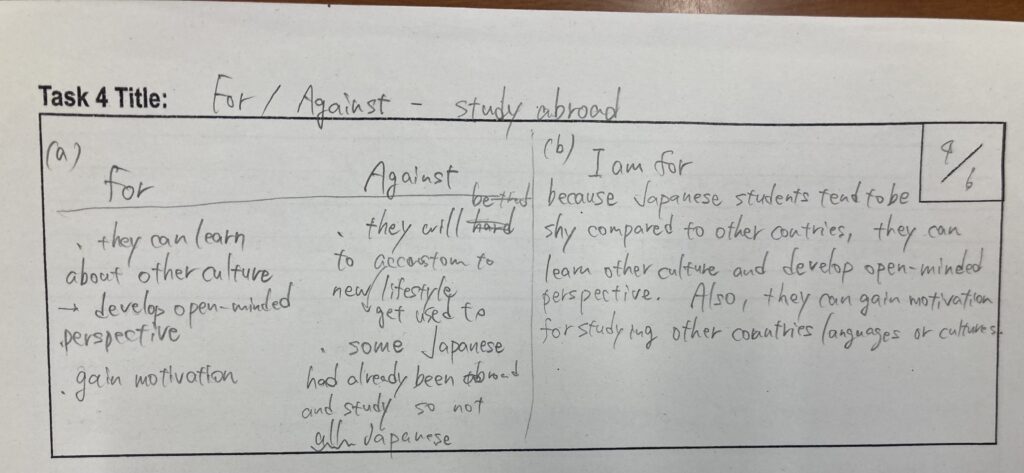
Study abroad for all Japanese first year university students is important (2weeks to 2 months). Are you for this idea OR Are you against this idea ??
Task 4: For / Against – study abroad (a) list 2 for and 2 against / (b) write a short answer, for example
a) for: 1) practice another language; 2) make new friends / family
a) against 1) who has to pay?; 2) when and who is organising
b) How can you write a short reply / response
I am for this idea because…
I am against this idea because…
I am not sure (neutral) because… to practice another language is a benefit, but it is difficult to plan
Student Example:
Task 5 Title: FOI (Facts of Information): internet
Research using the internet says that opportunity is increased for work with good language skills
In addition research shows that the cost for 1 month study abroad is up to 500,000 Yen.
…
…
Review: For and Against
this approach (way to answer a question. a way to give a response) is called subjective = you think about both answers or all of the answers (for/against/neutral)
share our own information
research the information
conclude our answer; we can use for / against / or neutral (anytime)
Task 6 Title: Diversity (four parts)
Write a short definition. What is diversity?
What are the main points about diversity in the video? (study the English words)
Rate Japans diversity from 1 to 5 (1 is least — 5 is high). Why? (30words)
Would you join the exchange program at this university? Yes / No
Task 2 Title: Main Points (c) / Support Sentences (d)
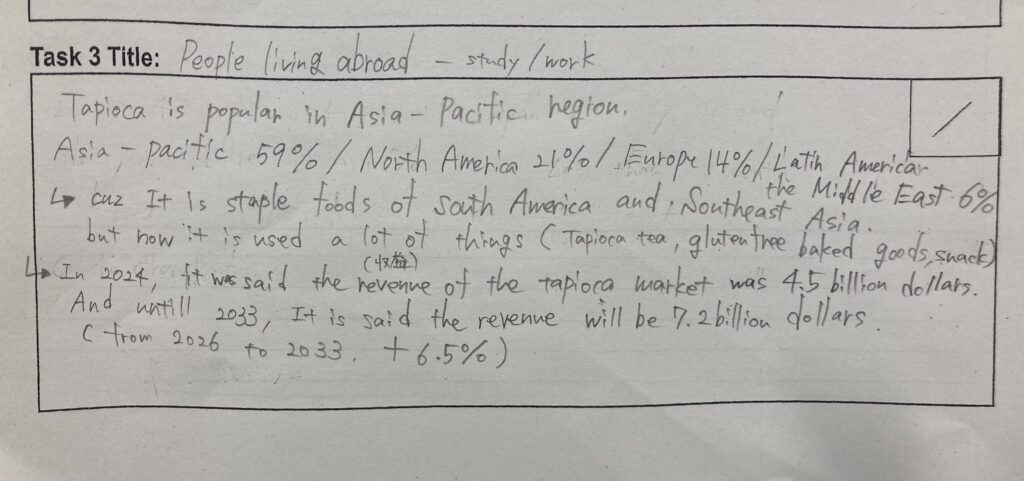
Task 3 Title: People living abroad – study / work [free writing]
find a statistic about this topic (anything) using Google search
write the sentence in English – 5 minutes
please read to your group members
Main Point = Facts of Information (FOI)
Support sentence – to give information about that fact.
Student example:
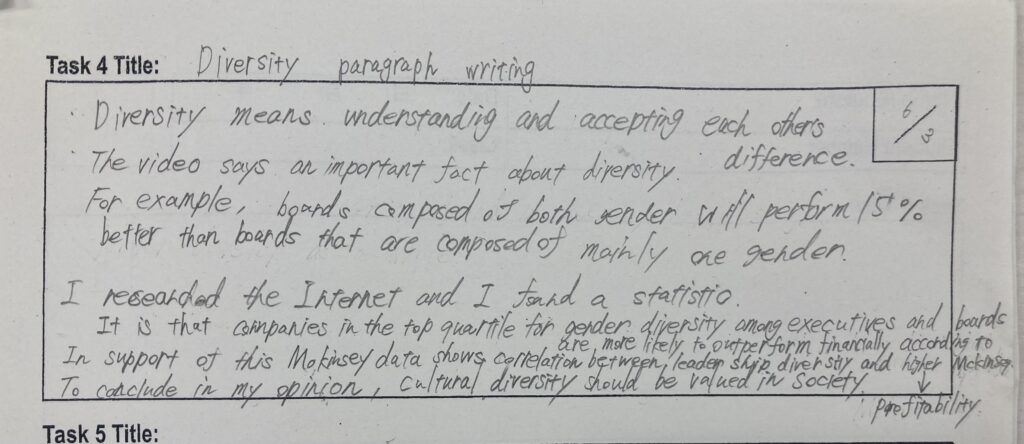
Task 4 Title: Diversity paragraph writing
Diversity means (write a definition in your own words:
The video says an important fact about diversity. For example, …
I researched the internet and I found a statistic. (fact of information). It is …
In support of this …
To conclude in my opinion, …
HOMEWORK
Task 1, 2, and 4 – finish
Quiz 5 –> Saturday 9am
Student example:
HOT Topic: Multi-cultural Is an expression we say to describe the diversity of culture in a country. I want you to know that a lot of countries respect Japan for its rich and deep and meaningful customs and traditions. Also, I would like Japanese young people (adults) to have more foreigners as friends. So, please travel.
June 1 Aim: To share and discuss about culture and revise our notes
Steps: follow these steps;
check your homework notes; read and highlight the main points, vocab, and phrases
task 2: prepare and teach the subject; use information; opinion; example – about 1 minute; highlight the key text (eye contact); and record when teaching for your partner
upload the task activities; check the Moodle instructions
finish with a group and class discussion – how to teach a topic or subject?
Aim: To learn about what it is going to be like living in the future, and to express your opinions about the future
Method: Follow these steps. The teacher will give you a worksheet in class.
HOMEWORK: watch and learn the video topic and language
Class Activity
Step 1: Task 1: What is the definition of living in the future? Use the video to help you. Write your own words (20-25 words). Also write 15-20 key words (in English).
Step 2: Task 2: Listen to the video to learn about the topic. Think about the main points, how many main points are there? Write them.
Video
Step 3: Task 3: What is Hybrid Learning? Write your own explanation (20-25 words)
Step 4: Task 4: The main point “Redesigning work spaces” is a new concept for work. Explain this idea: (50words)
Step 5: Task 5: At 1:30 – “Office Study” is talked about. Explain what this study was about. (35words).
Step 6: Task 6: What are the challenges for the future? Explain them. Can you think of one challenge yourself?
Speech format: there will be 7 sentences to write a speech about your health [topic]. Sub-topics are categories / ideas to help explain the topic. For example; select any of these: 1 or 2 or 3 or …
physical
mental
social
diet [your ideas]
exercise [your ideas]
study [your ideas]
…. [any ideas]
7 Sentences: speech writing format
Introduction. Today I am going to talk about …. [explain your topic]
Main Point 1
support sentence for [MP1]; example, reason, idea, past experience
Main Point 2
support sentence for [MP2]; example, reason, idea, past experience
Opinion about: why is health important for university students? Answer: […]
To conclude … [final sentence / summary]
HOMEWORK
no written homework
Quiz 3 (Saturday 9am to Thursday 1pm)
May 28th video recording
Method: to self record a video of your speech (selfie): follow these steps:
Check you have 8-10-12 highlighted words/phrases
Reading and look up & speak for the highlighted words
Practice before recording: the teacher will give you recording instructions
Conversation Activity: Speaking and Techniques – Role Play