Video Template

[Video Name]

[Topic Name]

Aim: In this topic you are going to learn about the meaning of “…” and why it is so important.

Objectives: read the activity objectives below;

  1. Listening comprehension: to watch a topic video and learn the key vocabulary and language
  2. Reading comprehension: to practice reading and learn paragraph writing format styles
  3. Writing: to research an endangered animal and write a short report – paragraph format
  4. Speaking: prepare a short 1 minute presentation about your endangered animal

Video Watch the video two times and follow the steps below. There are two steps.

Step 1: First, watch the video with no subtitles, and try and understand the content – what is the topic about? Do not take notes at this stage, just listen.

Skill exercise:

  • Listen for the main points in the video
  • Remember key words or phrases

Step 2: Watch the video a second time with English subtitles and follow the skill exercise.

Skill exercise:

  • Write keywords or phrases – also called topic vocabulary or specialised vocabulary
  • Identify the main points – write them
  • Identify the support sentences explaining the main points

References

Alwehaibi, H. O. (2015). The Impact of Using Youtube in EFL Classroom on Enhancing EFL Students’ Content Learning. Journal of College Teaching & Learning12(2), 121-126. PDF link

Brook, J. (2011). The affordances of YouTube for language learning and teaching. Hawaii Pacific University TESOL Working Paper Series9(1), 2. PDF link

Speaking Assignments (home)

Method 1: record your presentation using your smartphone and computer

Set up – look at the student example. The student is next to the screen. The script (palm cards) and smartphone is in front of her.

  • The presenter is sometimes looking at the script (picture 1position);
  • and sometimes looking at the camera (picture 2position);
  • and sometimes looking at her screen (picture 3position).

Language Goals

The course goals for the main activities for 1. listening, 2. reading, 3. writing, and 4. speaking are:

1.Listening Goals:
1.Students can understand the main points of short discussions spoken by the teacher, and other students in group discussions in topic groups
2.Listening to media such as audio or video – YouTube (subtitles provided for support)
3.Can comprehension presentations conducted by other students

2.Reading Goals:
1.Students can read to understand the main points of English articles adapted for educational purposes,
2.Be able to search the internet and read information on topics.
3.Can read and understand simple problems and issues, and can understand processes or cycles

3.Writing Goals:
1.Students can understand, identify and write the main points of English
articles adapted for educational purposes,
2.Be able to write and paraphrase information on topics.
3.Can write to describe simple problems and issues, and other processes or
cycles

4a.Speaking Goals – Production
1.Students can talk in some detail about their experiences, ideas and points of view
2.Express opinions
3.Use topic based vocabulary, phrases and other target structures about class topics.

4b.Speaking Goals – Interaction
1.Students can express opinions and exchange topic based information in pairs or small groups
2.Can ask and respond to basic questions

Self-Introduction

1. Self-introduction (5 minutes)

Aim: Please include your experience related to teaching English.

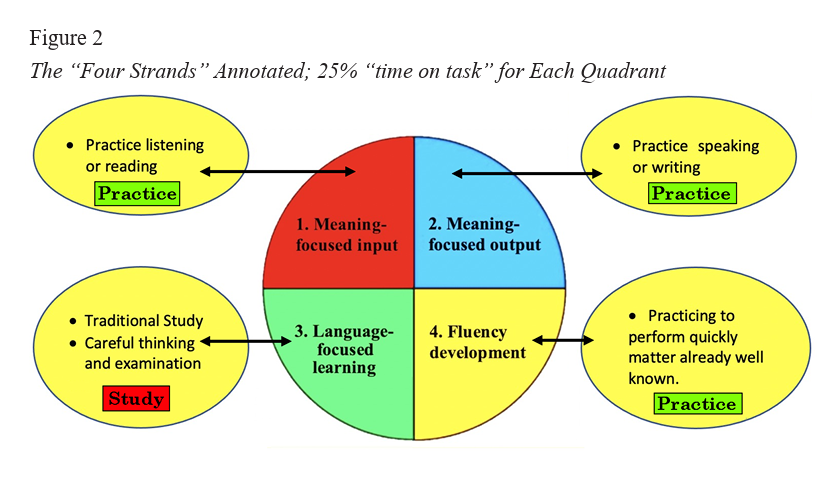
1.Philosophy: When designing teaching content and curricula, I follow something very similar to Paul Nation’s Four Strands model:

***The model is applicable to various contexts, including online teaching and specialized language courses.

  1. Meaning-focused input; Learning through listening and reading, where the focus is on the message/content, and 98% of the vocabulary is familiar.
  2. Meaning-focused output; Learning by producing language through speaking and writing, with focus on communicating meaning.
  3. Language-focused learning; Study of language features, including vocabulary, grammar, spelling, and pronunciation, often through direct instruction.
  4. Fluency development. Improving access to known language items across the four skills (listening, speaking, reading, writing) by working with familiar content.