Dec 5: Self Study Unit & Speech Practice

Objective: Today is a Self-Study lesson to complete your writing activity. While you are working on your worksheet, we will do practice speeches with the teacher.

Save you speech on a USB

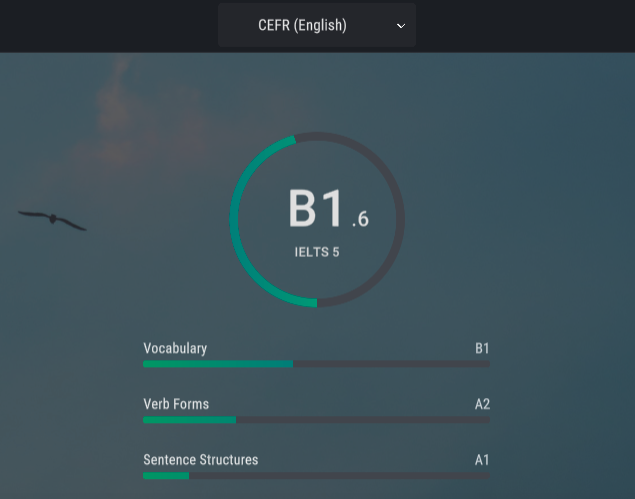
Upload your Speech CEFR: take a screenshot. When you finish show the teacher. You can finish today’s class.

1. TextBox: Final presentation Dec 5th [please type]

2. Upload screenshot

3. Write the details; CEFR Level; name; student number; email address; submit

Unit 9: Living in the Future (LF)

Topic: Living in the Future (LF)

Aim: In this topic you are going to learn about the meaning of “Living in the Future” and focus will be the theme “work”

Objectives: read the activity objectives below; *please note at this stage of the course the tasks are combined

  1. Listening comprehension: to watch a topic video and learn the key vocabulary and language
  2. Reading comprehension: to practice reading and learn paragraph writing format styles
  3. Writing: to research an endangered animal and write a short report – paragraph format
  4. Speaking: prepare a short 1 minute presentation about working in the future

Reading exercise: HI

[0:07]

Human Impact

The year is 2100. Human population has reached 10 billion. As temperature rises, and ice caps continue to melt, rising sea levels have caused huge swathes of land to be permanently underwater. Major cities such as London, New York, and Mumbai no longer exist. Millions of people have had to leave their homes. City population have risen and stepping outside means breathing in extremely polluted air and endangering your life. [paragraph 1]

Once fertile farmland has become unworkable as soil turns into dust. The number of people not getting enough food increases. Rivers and seas are polluted. The provision of clean water and ever-increasing problem. This sounds like the plot of a dystopian novel, but it could end up being real. Since the Industrial Revolution in the late 19th century, the human population has exploded, and is now growing at an exponential rate, with no signs of slowing down. More people demand more resources and create more pollution, and ever-increasing impact on Earth. [paragraph 1]

Humans cause pollution by burning fossil fuels. We are relying on them for transport and electricity generation. Burning fossil fuels releases carbon dioxide into the atmosphere, which is a greenhouse gas. Increased greenhouse gases caused an increase in average global temperatures known as the greenhouse effect. This is linked to climate change. Some areas of the world are getting wetter and others hotter and drier, and these changes have an impact on ecosystems and biodiversity. If you want to learn more about biodiversity, and why it matters, watch this video [Biodiversity]. For example, warmer weather in the Arctic, and the subsequent melting of the sea ice, has an effect on animals that living there. The polar bear is no longer well adapted for living in its habitat, and is an endangered species. [paragraph 2]

Humans also require resources. Large areas of forests are cleared to make more room for agriculture, also mine minerals or for growing other resources like palm oil. The removal of trees is called deforestation, and has an enormous impact on not only the local ecosystem, but the entire planet. Ancient forests such as rainforests are unique ecosystems. They can support a high biodiversity, and are home to species that can only live in that habitat. For example, in Borneo rainforests are being cut down to make room for palm oil plantations. The species that live in the rainforests cannot survive in the plantations. They may not be able to find food or shelter. Like orangutans, who are an endangered species. You can find out more about endangered species and how conservation is helping them, by watching this [Endangered Animals] video. [paragraph 3]

Forests provide services to the planet. They are important in the water cycle, recycling fresh water across the globe. Trees are also able to take in and store carbon dioxide, which helps regulate the earth’s temperature, as well as burning fossil fuels and deforestation. Humans also create lots of waste sewage, pesticides, and fertilizers enter the water, and may contain toxic substances that can kill organisms, and impact on whole food webs. Pesticides can accumulate in the tissues of organisms, and stay in the environment for many years before being broken down. [paragraph 4]

A combination of a growing population and a throwaway culture. We also have increasing demands for dirty, wasteful landfill. But let’s end on a happier note. There is some hope. People are coming to realize the impact we are having on the environment, and governments are aiming to cut down their reliance on fossil fuels, and put in schemes into place to help protect forests and endangered species. [paragraph 5]

So in this video you’ve learnt about how human activity has a negative impact on the earth because of burning fossil fuels, deforestation and creating waste. [paragraph 5]

Reading exercise: ES

[0:05]

Endangered Species

You can probably name quite a few endangered species. Polar bear, blue whale, and black rhino are just a few. But there are many more that don’t get so much attention. There are currently around sixteen and a half thousand animals and plants that are endangered. [paragraph 1]

An endangered species is one that is at a high risk of becoming extinct, which is when there are no longer any members of that species alive. Lots of species are going extinct every single day. Sometimes this is because of natural causes. Extinction is part of evolution after all. But many more because of human activity. In fact, because of humans, the rate of extinction is estimated to be 1,000 to 10,000 times higher than what would occur naturally. This is the highest rate since the extinction of the dinosaurs 65million years ago. [paragraph 2]

Conservation is the act of protecting species against becoming endangered. It’s all about preserving biodiversity. If you want to learn more about biodiversity and why it matters, watch this video [BIODIVERSITY]. You might wonder why it’s such a big deal. [paragraph 3]

Why does it matter if the population of a species decreases so much that it is endangered. Surely if there are a few individuals such as those in zoos, then a species can recover. The problem is that the key to having a healthy population, is genetic variation. Within a population, you need a large variety of different characteristics, so that a species can adapt if there is a change in the environment, and avoid becoming extinct. This can happen, if all the members of the species have similar genes. Also, in a small population, there is a high chance of inbreeding. Where closely related individuals breed. This can increase the risk of offspring having inherited conditions. So large wild populations are important for a species survival. [paragraph 4]

There are many reasons why a species might become endangered. It can happen because of a habitat destruction, climate change, over fishing or hunting, and the introduction of invasive species to habitats which out-compete the native ones. We have an ethical duty to help preserve all the species on earth, and this is done by carrying out conservation. Let’s look at a few methods used. [paragraph 5]

[2:30]

Firstly endangered animals can be housed in wildlife parks. This protects them, and also captive breeding programs can be used to increase their numbers. They help educate people about conservation, and how we can all help protect endangered species. They also help the general public to form an emotional connection to these endangered species, however there are disadvantages to animals in captivity. The animals do not lead a normal life, and there is risk of inbreeding. [paragraph 6]

A way of protecting animals in their natural habitat, is by creating protected areas like national parks. Trees cannot be cut down, roads and houses can’t be built, and hunting of the animals is illegal. Rangers are employed to make sure this is enforced. It’s not just animals. [paragraph 7]

Plants are also at risk. An amazing 70 percent of plant species are endangered, so it’s vital that we help protect them too. As well as using protected areas, plants that are endangered are preserved by collecting seeds, and storing them in seed banks. If a plant does become extinct, the seeds can be grown to restore their populations. [paragraph 8]

To recap an endangered species is one that is at risk from extinction the main causes of which are human activities. Protecting vulnerable species is called conservation, and there are many methods to do so, including wildlife parks and protected areas. [paragraph 9]

[3:48]