Submission

Follow these steps

Steps:

  • 1. Print

Print your PowerPoint slide (practice only) You do not need to submit to the teacher. Please take a photo of every slide and upload to LINE Group.

  • 2. Present

This class will use LINE to submit media.

– We need to make aegr# groups. For example Group 1: aegr1 (LINE group name)

– Present your speech: Record video and upload to your group – no mask.

  • 3. Take a photo of your speech card. Remember to look at the camera when you read your high light points!

Deadline: Video – In class / Outside class; PowerPoint photos In class / Outside class

Speaking Techniques

Objective: The teacher will demonstrate one way to present an effective speech

  • write your script on the speech card
  • highlight the key vocabulary / expressions
  • read your card, but look up at your audience and say your “key vocabulary / expressions”
  • stress these words
  • make eye contact with people as you say them
  • the teacher will give you class time for practice

Speaking: ES for PC room

Aim: To prepare a short speech presentation about your Endangered Animal

Method: To use a rubric or assessment criteria to plan and evaluate a speech and PowerPoint Presentation

Objective: To convert your short paragraph (writing exercise) and write a script using PowerPoint template:

  • reading your paragraph is not a speech
  • you should change the paragraph for the speaking exercises
  • you have to use the time, for example 10s or 20s
  • the total time is 60seconds

Procedure: Use the template below to make your presentation. Open a new PowerPoint document and;

  • Write the title “My Endangered Animal: AnimalName”
  • Save your document: My Endangered Animal: AnimalName.pptx
  • Back up your document on USB; also print your PowerPoint
  • Complete the template below

Presentation Template

Writing exercise: ES

Aim: To write a a short paragraph about an Endangered Animal

Objective: To write a paragraph following a paragraph-writing format to give information.

Method: Research the internet about an endangered Animal. Follow the sentence structures below to write your short paragraph. There are seven sentences.

Procedure: Open a new word document and;

  • Write the title “My Endangered Animal: Animal-Name”
  • Save your document: MyEndangeredAnimalAnimal-Name.docx
  • Back up your document on USB
  • Complete the sentences below
  1. Topic Sentence: Write a sentence to introduce your animal
  2. Main Point 1: Write a sentence to give information about this endangered animal
  3. Support Sentence 1: Give more details to explain the above point
  4. Main Point 2: Write a sentence to give information about this endangered animal
  5. Support Sentence 2: Give more details to explain the above point
  6. Opinion Sentence: Write your opinion
  7. Conclusion Sentence

Teacher Example: Draft report

My Endangered Animal: Numbat

1. The animal ‘Numbat’ is an Australian marsupial found in Western Australia. 2. There are only 2 different areas where you can find this animal. 3. There are also some human habitats for this animal. 4. This animal only eats termites and eats only during the day. 5. They sleep at night and live in a protected place, so they only eat in the day time. 6. I think that we should try to protect this animal from other animals at night. 7. The ‘Numbat’ is a cute looking animal and we should help to protect and breed this animal.

Format Method for Writing:

Homework Activity:

  • Read your writing (draft) and check your information
  • Check your video notes: Did you use any key words or grammar sentences? (target language – T/L)
  • Try and add some key words or T/L sentences
  • Read and check again
  • Finish for HomeWork – show me (teacher) in the next class

May 13 Aim: To prepare for your speaking exercise;

  • Check your speech – maximum two sentences for each task.
  • Highlight / underline your key words – important sentence words / topic words.
  • Count – how many keys words do you have? You need a minimum of 15.
  • Next recording; see link

Listening exercise: Endangered Species ES

Endangered species

Video Watch the video two times and follow the steps below. There are two steps.

Step 1: First, watch the video with no subtitles, and try and understand the content – what is the topic about? Do not take notes at this stage, just listen.

Skill exercise:

  • Listen for the main points in the video
  • Remember key words or phrases

Step 2: Watch the video a second time with English subtitles and follow the skill exercise.

Skill exercise:

  • Write keywords or phrases – also called topic vocabulary or specialised vocabulary
  • Identify the main points – write them
  • Identify the support sentences explaining the main points

Unit 1: Endangered Animals (EA)

Topic: Endangered Animals (EA)

Aim: In this topic you are going to learn about the meaning of “Endangered Species” and why it is so important.

Objectives: read the activity objectives below;

  1. Listening comprehension: to watch a topic video and learn the key vocabulary and language
  2. Reading comprehension: to practice reading and learn paragraph writing format styles
  3. Writing: to research an endangered animal and write a short report – paragraph format
  4. Speaking: prepare a short 1 minute presentation about your endangered animal

Reading exercise: ES

[0:05]

Endangered Species

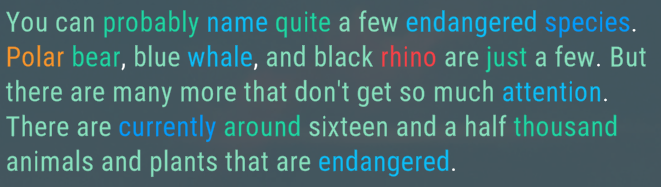
You can probably name quite a few endangered species. Polar bear, blue whale, and black rhino are just a few. But there are many more that don’t get so much attention. There are currently around sixteen and a half thousand animals and plants that are endangered. [paragraph 1]

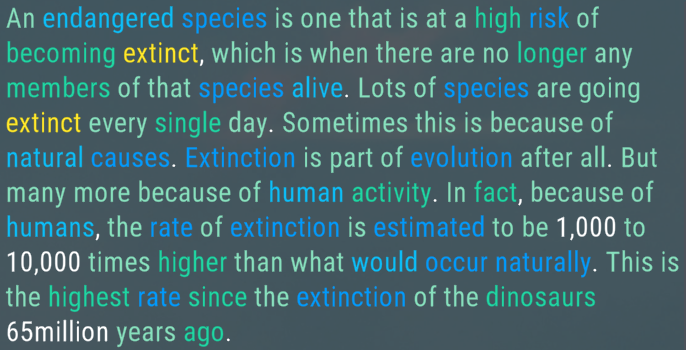
An endangered species is one that is at a high risk of becoming extinct, which is when there are no longer any members of that species alive. Lots of species are going extinct every single day. Sometimes this is because of natural causes. Extinction is part of evolution after all. But many more because of human activity. In fact, because of humans, the rate of extinction is estimated to be 1,000 to 10,000 times higher than what would occur naturally. This is the highest rate since the extinction of the dinosaurs 65million years ago. [paragraph 2]

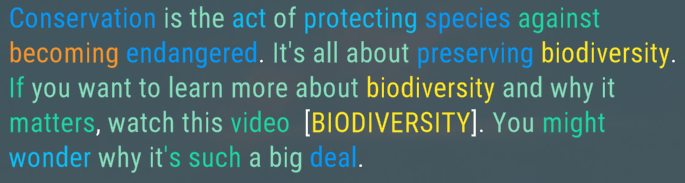
Conservation is the act of protecting species against becoming endangered. It’s all about preserving biodiversity. If you want to learn more about biodiversity and why it matters, watch this video [BIODIVERSITY]. You might wonder why it’s such a big deal. [paragraph 3]

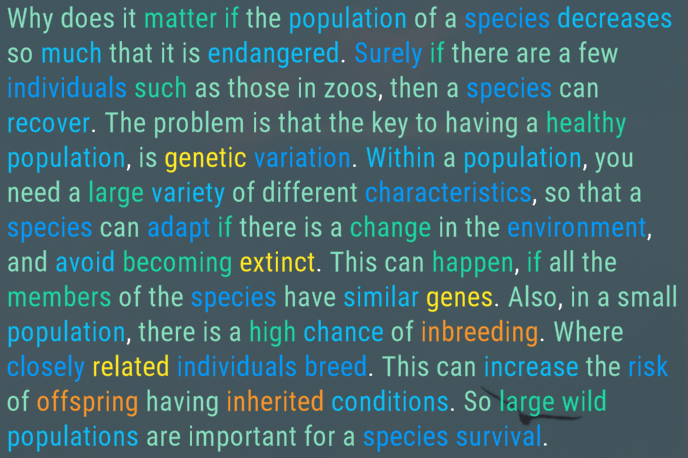
Why does it matter if the population of a species decreases so much that it is endangered. Surely if there are a few individuals such as those in zoos, then a species can recover. The problem is that the key to having a healthy population, is genetic variation. Within a population, you need a large variety of different characteristics, so that a species can adapt if there is a change in the environment, and avoid becoming extinct. This can happen, if all the members of the species have similar genes. Also, in a small population, there is a high chance of inbreeding. Where closely related individuals breed. This can increase the risk of offspring having inherited conditions. So large wild populations are important for a species survival. [paragraph 4]

There are many reasons why a species might become endangered. It can happen because of a habitat destruction, climate change, over fishing or hunting, and the introduction of invasive species to habitats which out-compete the native ones. We have an ethical duty to help preserve all the species on earth, and this is done by carrying out conservation. Let’s look at a few methods used. [paragraph 5]

[2:30]

Firstly endangered animals can be housed in wildlife parks. This protects them, and also captive breeding programs can be used to increase their numbers. They help educate people about conservation, and how we can all help protect endangered species. They also help the general public to form an emotional connection to these endangered species, however there are disadvantages to animals in captivity. The animals do not lead a normal life, and there is risk of inbreeding. [paragraph 6]

A way of protecting animals in their natural habitat, is by creating protected areas like national parks. Trees cannot be cut down, roads and houses can’t be built, and hunting of the animals is illegal. Rangers are employed to make sure this is enforced. It’s not just animals. [paragraph 7]

Plants are also at risk. An amazing 70 percent of plant species are endangered, so it’s vital that we help protect them too. As well as using protected areas, plants that are endangered are preserved by collecting seeds, and storing them in seed banks. If a plant does become extinct, the seeds can be grown to restore their populations. [paragraph 8]

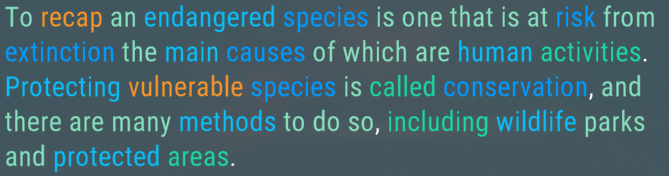
To recap an endangered species is one that is at risk from extinction the main causes of which are human activities. Protecting vulnerable species is called conservation, and there are many methods to do so, including wildlife parks and protected areas. [paragraph 9]

[3:48]