Lesson 2-3 / April 21-28

Objective: To learn how to read a text [ stage 1 ]; how to write a summary [ stage 2 ]

Method stage 1: There are several steps for reading. We need to know the these steps and practice it.

Task: READING SKILL Previewing: it is important to preview (check) the text before you start reading. Because we want to know what the text is about? For example:

  1. Read the Title: understand the meaning; use your dictionary to help you
  2. Read the headings: these are main points of the text information
  3. Read other captions (sub-headings) of text; pictures; diagrams

Question: Can you understand what the text is about? Please try to understand everything about it.

Task 2: Make a list of everything you can see in this webpage p.4-5: Title / headings / pictures / captions / questions – answers / …

  • Title : The Winter Hill Career Center
  • Headings: The right job for you / What are your interests and skills / What jobs match your interests and skills / Visit us to make your career plan!
  • Captions / Pictures: Type 1 to Type 6 / Job pictures
  • Information: Text / Check mark and [ ]check boxes / Questions and Answers

Task 3: Read [ all of the text ] one time. Understand the text and ideas!! Read another time (repeat) and highlight the words you don’t understand – highlight pen. Next check the meanings of these words using your computer. Google / Weblio / …

Question: What is this website (text) about? Please write (20-30/40-50 words). We write the main points (MP).

  • MP1: Is …..
  • MP2: Is …..
  • To conclude (finish) …..

***Why do we work in pairs? or small groups? to HELP each other with ideas / English / to understand / with anything !!!

Task: Read [ all of the text ] with your partner – read different sections each.

HOMEWORK before next class

  • Review the Reading; check the meaning / ideas / words …
  • 1 or 2 times Read aloud – focus is not to make any mistakes [Accuracy]
  • Exercises page 7 – B / C / D. 1) Exercise C. 2) please do (B).
  • Then, do exercise (D) and match the work type with the picture (occupation).
  • Last, think about the topic. Which work type are you? Write about 30-50 words Task 4: response

For example: I think I am work type [ … ]. I have a few reasons why. Reason 1 is [ … ]. Reason 2 is [ … ]. In the future I might become a [ job name / occupation ].

Lesson Finish————————————————————————————————- Here:)

Task: READING SKILL Previewing

Pre (before something) view (means to look and understand the main parts of a reading passage)!!

: it is important to preview (check) the text before you start reading. Because we want to know what the text is about? For example:

  1. Read the Title: understand the meaning; use your dictionary to help you
  2. Read the headings: these are main points of the text information
  3. Read other captions (sub-headings) of text; pictures; diagrams –
  4. Interview passage Q / A
  5. 4 questions
  6. 4 responses (A)
  7. 3 pictures of different jobs; what is your image of the pictures
  8. word key

Reading Method: The person asking the questions is an interviewer (reporter); the person responding is talking about their work.

  • highlight or underline the words you do not know?
  • check the dictionary / google / weblio / …
  • write the Japanese word or meaning in the passage.

Objective: to connect the reading passage 1 and 2

  • go to page 6 and in your groups select a job – different than your group members
  • In Task 5 Title: Interview
  • Write the first Q1. What do you do?
  • Answer A1: I’m a carpenter. I work for Daichi Homes, which is a large building company in Japan
  • Q2. What are your responsibilities?
  • A2. …
  • Q3. …
  • A3. …
  • Q4. …
  • A4. …
  • check with your partner / correct any mistakes
  • practice the interview with your partner – reading aloud techniques

Reading Aloud Strategy: practice these techniques; the same image as a podcast on YouTube – its usually relaxed (natural talk)

  1. in an interview we often make eye contact
  2. stress key words – these are the words that help answer the question
  3. sound natural
  4. the interviewer (asking questions) should be interested in the responses – nod our heads / smile for interacting / …
  5. responder – use friendly gestures

Task 6 Title: Free Writing (2)

– follow these steps to write your response; write quickly and as much as you can

  1. read the topic: My Golden Week plan
  2. think about the topic for 1 minute; what are your main points; what are your details (information) where / what / who -who with / why …
  3. 5 minutes to write
  4. count your words / write in the corner box
Lesson 1 – April 17th

Objective: Self Introductions / Part-time work / …

Task 1 Title About myself

Please introduce yourself to your partners in English;

  • name / nickname “Please call me Simon”
  • hometown
  • course name [in English]
  • interests / sports / nusic
  • club activity / circle
  • part-time job?

Task 2: Ranking part-time jobs for university students

Objective: Make a list of 5 different jobs, for example Juku teacher. (1) is the top job

Step 1: make a list from 1 to 5. Number 1 is the best job.

Step 2: Lets compare in class;

  • think about other groups responses
  • do you agree or disagree?
  • what job would you like to do?

Step 3: with your partner(s) select one job and write 2 good points / two bad points

2 good points

  • 1 good point
  • 2 good point

2 bad points

  • 1 bad point
  • 2 bad point

Lesson 1 – April 14th

Task 1: Self Introduction

  • name
  • hometown
  • interest / hobby
  • sports / music / free time

Hello. My name is Simon Townsend. Please call me Simon. My hometown is Brisbane City. But now I live in Hachimantai City. I am interested in cooking Italian food. I also like playing sports. In summer I like to go hiking because I like nature. In my free time I enjoy meeting friends and taking onsen.

Task 2: Part-time job

There are many kinds of part-time jobs for university students. Some students work in cloths stores, ramen shops, Juku teacher (private school), and so on…

Q. Do you think students should have a part-time job?

  • write two good points
  • write two bad points

A. I have two good points and two bad points about working a part-time job. First, the good points are… Next, the bad points are… In conclusion, I think [ its good for students / not good / both good and bad ] because…

Task 3: In your groups; make a list of 7 part-time jobs for university students; Next step – rank from 1 to 7. Number 1 is the best job, the second best job is (2) …. and so on.

  • Juku teacher
  • 2
  • 3
  • 4
  • 5
  • 6
  • 7

Task 4 Title: to compare

  • Now think about the good points / bad points of the top 3 jobs on your list
  • two good points for each job
  • two bad points for each job

Task 5 / 6 >>> communication blog

Writing Fluency

Instruction: how to write quickly, how to write without unnecessary pauses

  • Include a 5-minute free-writing activity every week (or in most of weeks)
  • Before or after the 5-min writing, I show one strategy to write more quickly
  • to draw students’ attention
  • Give the same or similar topics
  • to familiarize themselves with the topic 

Student Strategy

A.Pre-Writing (30 seconds)

  1. Brainstorm using a spider map or listing
  2. Brainstorm with peers

B.While-Writing (4minutes)

  1. Focus on speed (e.g., ignore typos and errors)
  2. Use plain English
  3. Describe something when you don’t know the exact word.
  4. Learn from someone’s writing

C.Post-Writing (1minute)

  1. Use vocabulary tools (e.g., Longman English dictionary, Just the Word, WordHippo, DMM 英会話 なんてyou know?)
  2. Reflection on their performance 

L2 – April 24: Writing – Theme 1: Robotics (full exercise)

Aim: To learn about robotics and use the 2 basic writing skills (1. paraphrasing and 2. summarizing), and using dictionaries.

Activities: These activities are skills based. We are going to do a) individual and b) pair / small group activities

Lets start!

Task 4 Title: Paraphrasing Information

Skill 1: Paraphrasing the video in class and read the passage. How many Main points can you identify? Complete the exercises;

  1. Exercise: Make a list of the main points; MP1: There are two main processes; MP2: First items arrive (come) to the warehouse; MP3 Items are delivered and assigned; MP4
  2. Exercise: Write a description of the main points
  3. Exercise: Write the key words for each main point

HOMEWORK

Task 5 Title: Summarising Information (Amazon Video)

Skill 2: Summarising the video and passage. Write a short 40-50/60 word Summary of the topic

TEMPLATE:

This video is about [ … ]. There are several main points. These are [write MP1], [MP 2], and [last MP].

L2 April 24: Reading – Theme 1: Robotics (full exercise)

Aim: To learn about robotics and use the 4 basic reading skills (1. previewing, 2. predicting, 3. skimming, and 4. scanning)

Activities: These activities are skills based. We are going to do a) individual and b) pair / small group activities

Lets start!

Warm Up Activity

Skill 1: Preview the video in class. Watch the video. Then answer the question below (write 20 words)

Question: What is the video about?

Step 1: Read video transcript and watch and listen – repeat

Task 3 Title: Language and Information

Skill 2: Predicting the key words (important words or phrases) and complete the exercises:

  1. Exercise: Write a list of key words (5-10 words); two main processes [1] items are unloaded [2]
  2. Exercise: Do you have (GW) General Words / (E) Engineering OR (R)obot words?
  3. Exercise: Write the meaning for some words (3-5 words)

0:03 And then on this floor, we’ve got two main processes. So, one is to stow items that are just been received into the

0:11 warehouse. So, we receive them on the ground floor downstairs where the items are unloaded from a truck. They’re put into one of these many black totes,

0:19 moved around the building to a stow station, and very simply in a normal warehouse environment, you you have to

0:27 walk to a shelf, and this does the reverse. The shelf comes to you. So, it makes it much quicker, much easier. This

0:33 is a very highly automated robotic warehouse. We process millions of orders a week through this particular building

0:41 alone, which is one of over 30 within our UK network. Each of the orders that gets assigned to this building gets picked, packed, and shipped in less than two hours.

0:51 I think robotics is here to help us, and it’s a tool to aid us. The customer demand is forever increasing, and we’re getting the parcels out the door faster

1:00 than ever, and that’s what the robotics are here to help us with.

1:04 Only in the last few years have we really passed this inflection point where the automated warehouses are meaningfully more efficient than the

1:12 human warehouses. And so today the the Amazon fulfillment centers that are automated are are amongst the most efficient fulfillment centers in the

1:20 world. Amazon has invented a lot of its own technology uh to do that. Um and that has been a bit of a a competitive

1:27 moat for Amazon. But there are a lot of smart entrepreneurs that have developed alternative systems that other retailers are using.

Step 2: Read the color coded transcript

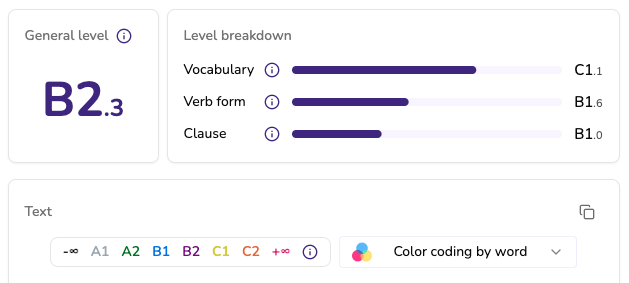
Skill 3: Skimming the words “color coding” and check the following;

  1. Exercise: Check the level of the words.
  2. Exercise: What was the level of your words in “step 1” and make a note* example A2 or B2
  3. Repeat Skill 2 and Skill 3 in a teachers activity

Step 3: Read the full paragraph

Skill 4: Scanning and reading the passage. Do you understand the passage more than before? Check the words you do not know.

And then on this floor, we’ve got two main processes. So, one is to stow items that are just been received into the warehouse. So, we receive them on the ground floor downstairs where the items are unloaded from a truck. They’re put into one of these many black totes, moved around the building to a stow station, and very simply in a normal warehouse environment, you you have to walk to a shelf, and this does the reverse. The shelf comes to you. So, it makes it much quicker, much easier. This is a very highly automated robotic warehouse. We process millions of orders a week through this particular building alone, which is one of over 30 within our UK network. Each of the orders that gets assigned to this building gets picked, packed, and shipped in less than two hours. I think robotics is here to help us, and it’s a tool to aid us. The customer demand is forever increasing, and we’re getting the parcels out the door faster than ever, and that’s what the robotics are here to help us with. Only in the last few years have we really passed this inflection point where the automated warehouses are meaningfully more efficient than the human warehouses. And so today the the Amazon fullfillment centres that are automated are are amongst the most efficient fullfillment centres in the world. Amazon has invented a lot of its own technology uh to do that. Um and that has been a bit of a a competitive moat for Amazon. But there are a lot of smart entrepreneurs that have developed alternative systems that other retailers are using.

Step 4: Reading Comprehensive exercise. Read the passage and choose the correct answer.

1.  Why does the warehouse bring the shelf to the worker instead of having the worker walk to the shelf?

A. It makes the process much quicker and easier.
B. Workers are not allowed to move around the warehouse.
C. It is required by building safety codes.
D. The shelves are too heavy for workers to move.

2.  What role do robotics play in the warehouse processes described in the text?

A. They act as a tool to aid humans in meeting increasing customer demand.
B. They package items using only human labor.
C. They have reduced the number of orders processed weekly.
D. They replace the need for receiving goods from trucks.

3.  According to the text, what significant development occurred in the last few years regarding warehouse automation?

A. Manual warehouses no longer exist in the UK.
B. Automated warehouses are now meaningfully more efficient than human warehouses.
C. Automated warehouses have become less efficient than human warehouses.
D. Robotics in warehouses have been banned in most fulfillment centers.

4.  Why is Amazon’s technology considered a ‘competitive moat’?

A. Other retailers have no technology.
B. It prevents Amazon from expanding internationally.
C. It lowers the number of orders shipped each week.
D. It is technology uniquely invented by Amazon that provides a competitive advantage.

Step 5: Short Answer exercise Read the passage and answer the questions with short responses (sentences).

1.  How does the shelving system in this warehouse differ from traditional warehouses?

2.  What role do robotics play in this automated warehouse?

3.  What recent milestone is mentioned regarding automated warehouses?

4.  How has Amazon maintained a competitive advantage with its fulfillment centers?

Friday Period 3

Available topics:

Key Engineering Fields at Iwate University: