Lesson 7/8/9 – June2/9/16 Unit 3

Vacations

HOMEWORK

  • quiz 4 (Saturday 9am – before the next class)(in class)
  • p46. A. / B.
  • p47-48. Reading: Managing Life and Work; take notes; learn the key words / phrases / main points

Task 6 Title: Free writing (Unit 3 warm-up): Question Where do you want to travel in Japan or Abroad? Where and why?

  • Upload Unit 2 worksheet and notes (in class) – Moodle Link

Task 1: Title p.49 C Identify (Shikibetstu – 識別する)

  1. Pro / Pros = positive points / good things (experiences)
  2. Con / Cons = negative points / not good (experiences)

Sentence examples:

1.[No.3] Pro: more creative when they come home – why? discover different ways people live – interesting — people feel creative in their thinking / better at solving problems

  • One of the pros for [long / short vacations] is that people …
  • One [positive experience / good point] for [long / short vacations] is that people …

2.[No.4] Con: people do not sleep well – why?

  • One of the cons for [long / short vacations] is that people …
  • One [negative experience / bad point] for [long / short vacations] is that people …

Task 2. Title: Sentences; finish for homework

  • write 2 example sentences for long vacation
  • 1 Pro
  • 1 Con
  • write 2 example sentences for short vacation
  • 1 Pro
  • 1 Con

Homework

  • Task 2 finish
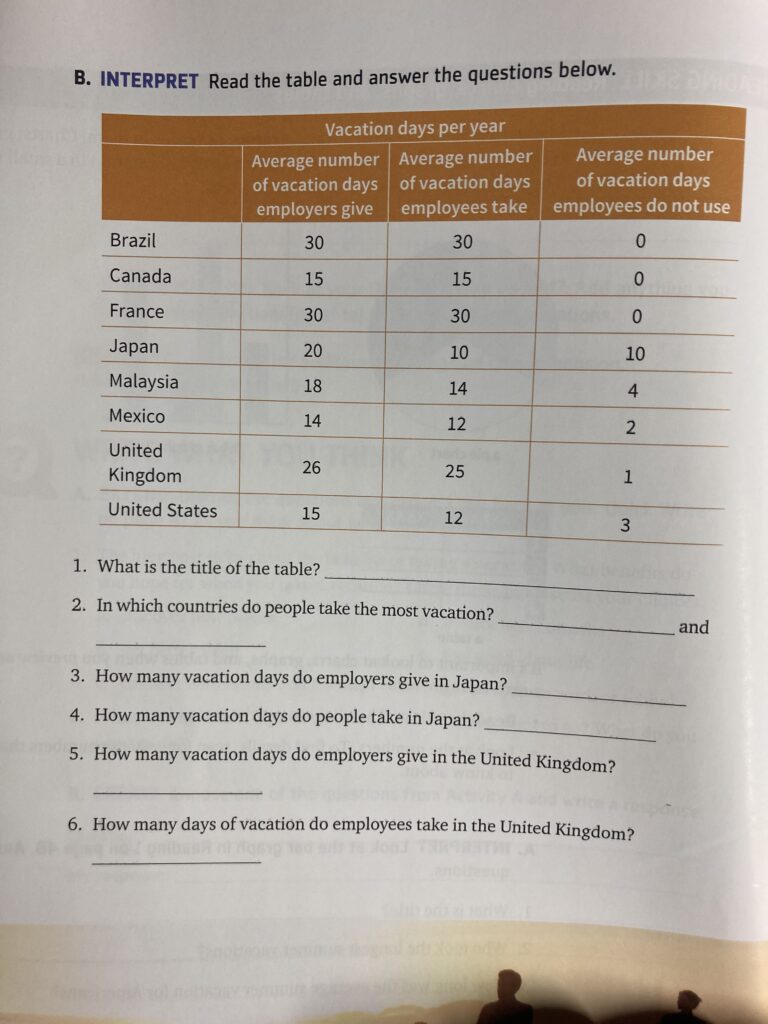
  • Task 3. Title: p52. B (1-6) Look at the Table and do the exercise
  • Quiz 5 – Saturday 9am –> (remember to log out after the quiz)

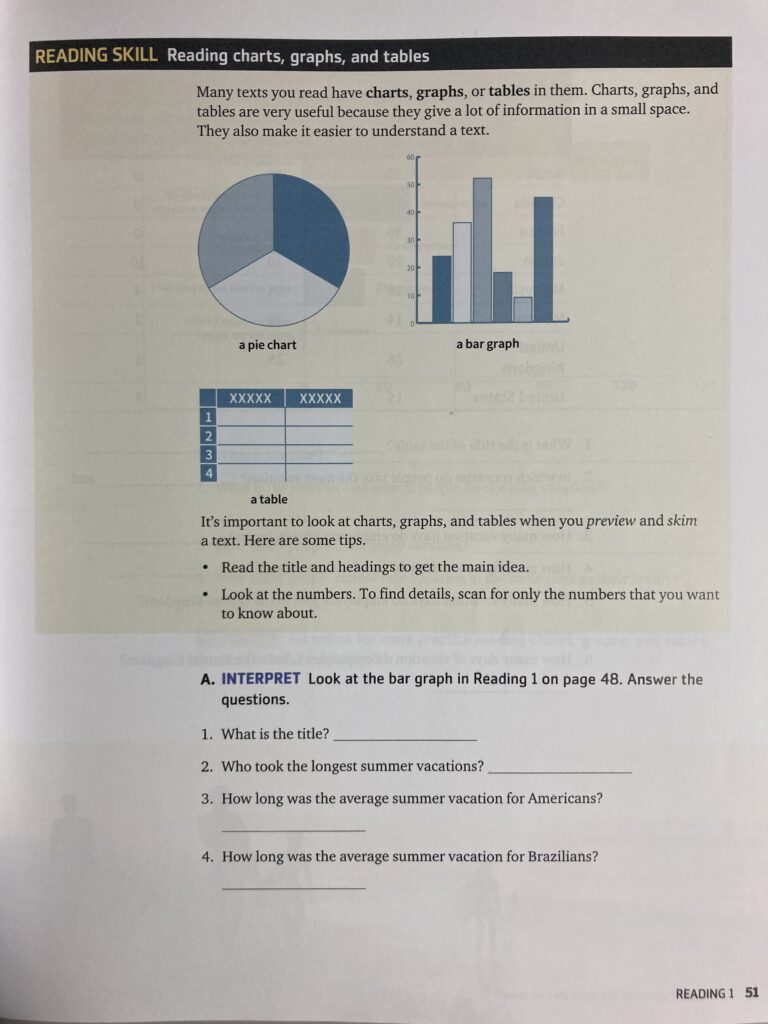
June 9th Aim: To read Tables and graphs

Task 3 Title. Reading a Table

  1. The title of this Table is “Vacation Days per Year” per=every
  2. Short Description: reading left to right; 1) The left side has 8 countries, 2) From there there is information in order starting with Average =====employees give, next Average =====employee takes, and finally 3) Not used days.
  3. Detail (Line 1): In Brazil they have an average of 30days vacation (1), they take an average of 30 days (2), and there are no days left (3).
  4. Line (2-8): … write the details for every country.
  5. Results (the groups and details) (Task 4)

Task 3 activity: select countries and write the sentences

Task 4 Title: Evaluation: groups / grouping method

  • Step 1: decide the result – what is the result?
  • Step 2: what groups can you see – think about it?
  • Step 3: make the groups [***Hint – there are three groups of countries]

Teacher example:

  • In group 1 / For group 1 : there are no days vacation left. These countries include Brazil, Canada and France.
  • In group 2 / For group 2 : there are a few days vacation left. There are four countries and they are Malaysia, Mexico, UK and the US. The days left are between 1 to 4 days.
  • In group 3 / For group 3 : there are a lot of days vacation left. There is only one country Japan [ and they only take half the numbers of days vacation / and take 10 days only vacation ]

Task 5/6 Title Table Report please write the whole report for Brazil, Canada, Japan, Malaysia, and Mexico.

HOMEWORK

  • Finish Task 5/6
  • Quiz 6

June 15

Activity continue: Graphs

Reflection (Note section)

Summary: What did we learn?

  • FOI (facts of information)
  • sources are: internet, journals, magazines, textbooks, … (where we get information from)
  • tables / graphs: there is a lot of information / helpful to understand a topic
  • American Standard for writing paragraphs; Topic sentence (1); Support sentences (ideas)(2-3-4); to finish we use a Conclusion sentence (usually a shorter sentence)(5)

Question: What is your best summer vacation? Answer with the American Standard (1-2-3-4-5)

HOMEWORK

  • Read the next topic: p.73-74 (30-45minutes)
  • check the language; key words (topic words); phrases; main ideas
  • use A4 paper / Campus paper
  • Saturday quiz – No7.

***this topic is “Physiology” check the meaning?

火曜日Lesson 5/6 – May 19/26

May 12 HOMEWORK

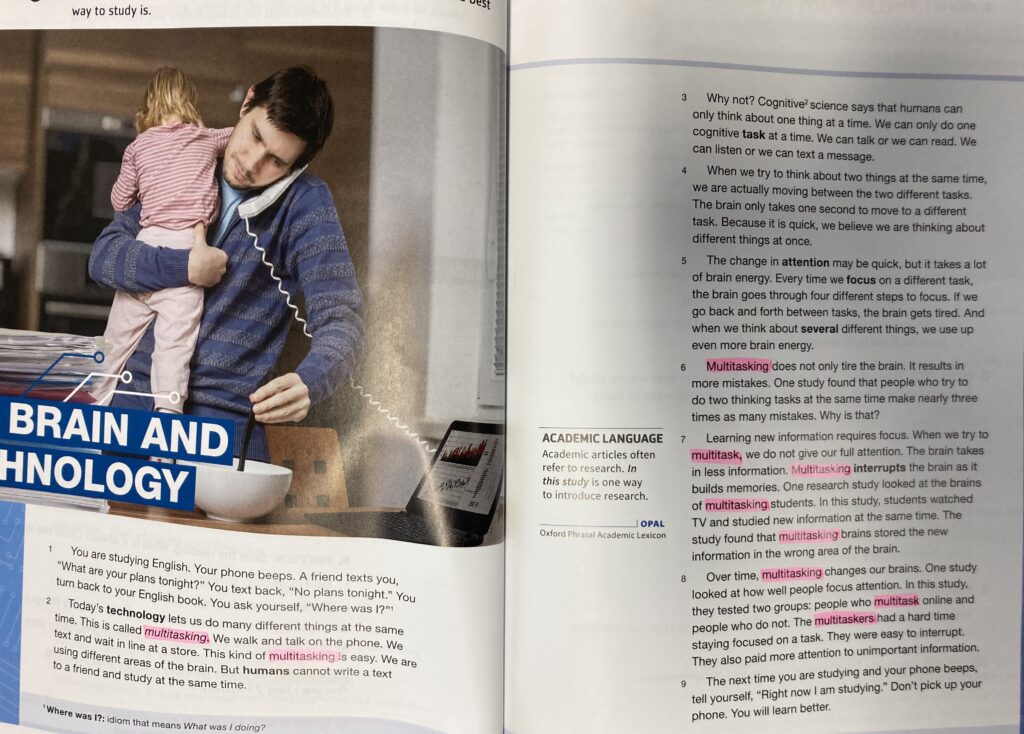
  1. Title: The Brain and Technology p.32/33. Please study this passage. Learn the vocab (words) and natural expressions (sentences). Bring your notes to class.
  2. Quiz : Open Saturday 9am

Sogo 2

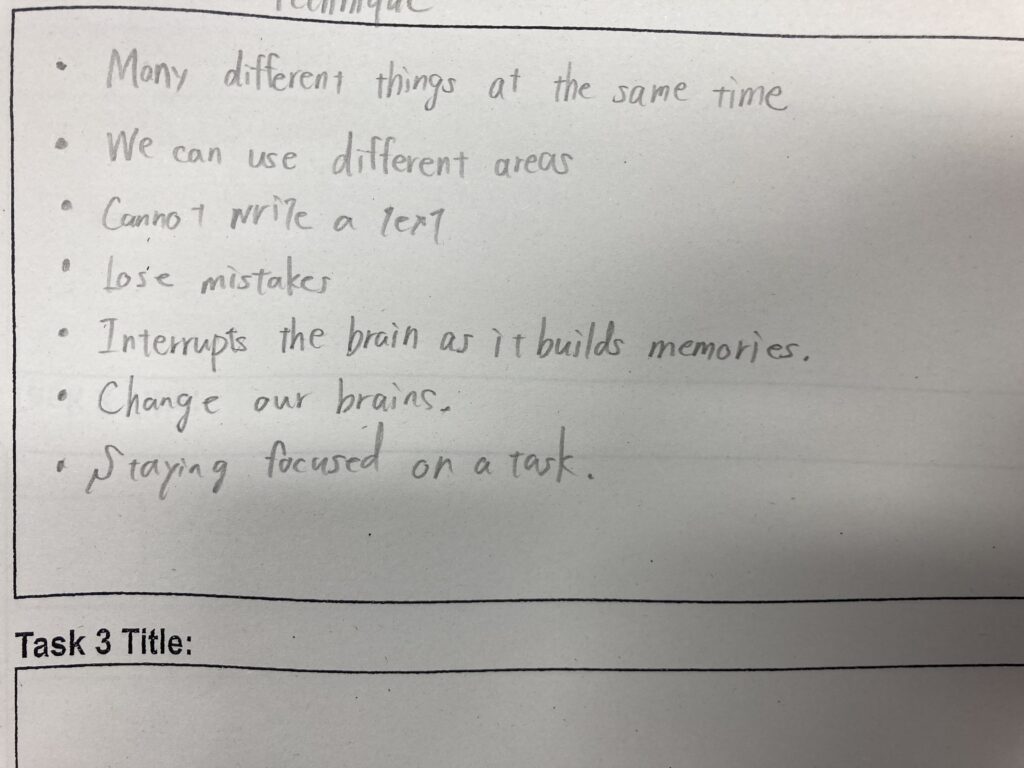
Task 1 Title: Multitasking

  • highlight every sentence with “multitasking”
  • please write the definition [2] line 4/5 “Today’s technology lets us do many things at the same time. This is called multitasking.”
  • please write every sentence with multitasking

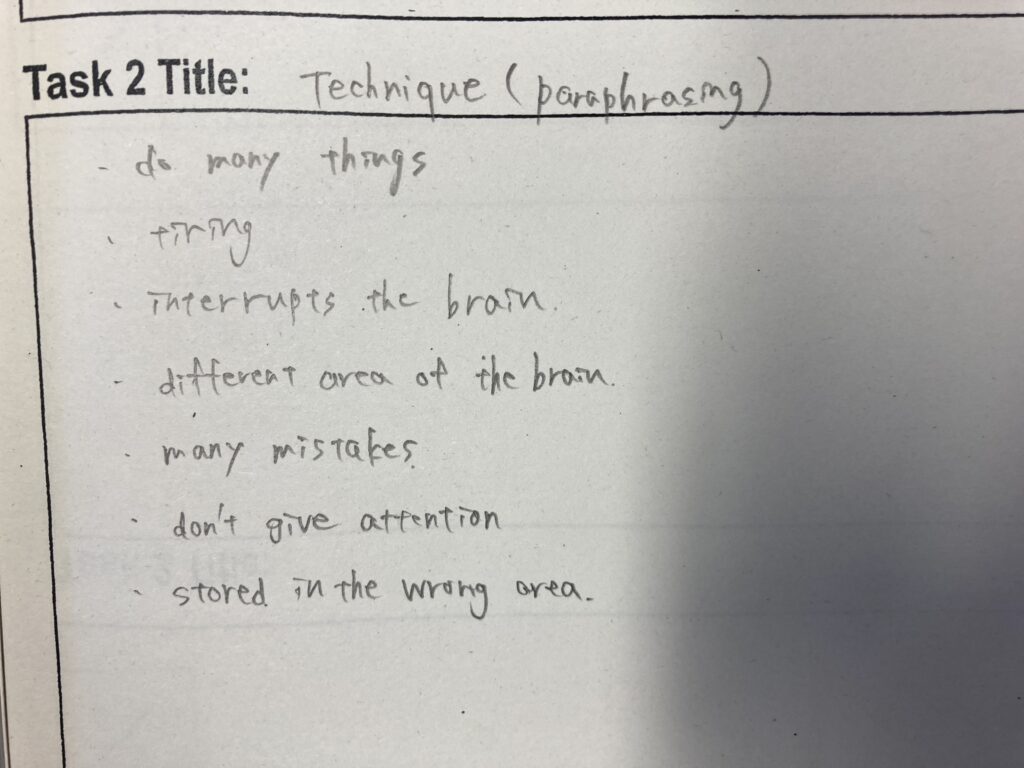
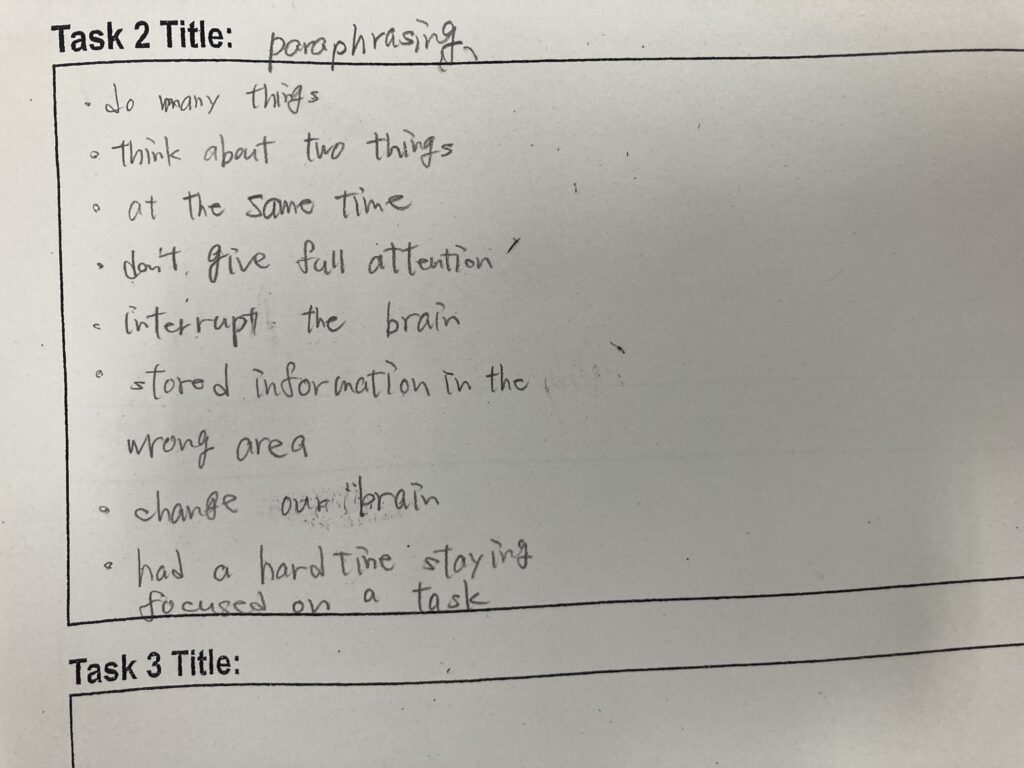
Task 2 Title: Technique [paraphrasing]

What is paraphrasing? We check a paragraph (text) / We check long sentences and change into short sentences called phrases (paraphrasing). For example: In a PowerPoint presentation we often use these phrases (bullet points).

Teacher example: multitasking

  • do many things
  • tiring
  • interrupts the brain

Student examples:

HOMEWORK

  • Task 3 Title: Can you multitask? a) yes; b) no; or c) sometimes (50-60words)
  • Quiz 3
  • May 12 activity speech card – please bring to the next class.

speech card example:

Activity: Preparing a response: (B) p.36

Steps:With your partner; select No.1 or No.2 (same)

  1. What is better for your brain? Study a little bit everyday (option a); Study a lot at one time (option b); OR (option a and b)

Activity: Preparing a response: (B) p.36

Task 4 Title: What is your answer and why? Write as much as you can (10minutes)

Grammar Activity: “but” and “so” (A/B) p.38

  1. So – when the second sentence is the result of sentence 1
  2. But – has opposite / different information than you think
  • I didn’t eat lunch, so I am hungry now.
  • I didn’t eat lunch, but I am surprised that I am not hungry.

***Note: we can express ourself easily using these sentences. Also we can explain something easily and people understand what we mean.

Task 5 Title: Reflect (D) No.1

  • Reading 2: Multi-tasking – p32-33
  • What did you learn about this topic (theme)?
  • What changes do you want to make about your own study?
  • What do you recommend as the best way to study for a test?

Hints:

  1. there is no right / wrong answer
  2. use some of the words (topic / key words) from the reading
  3. of course use the grammar [so/but] to express yourself

Lesson 1 – April 14th

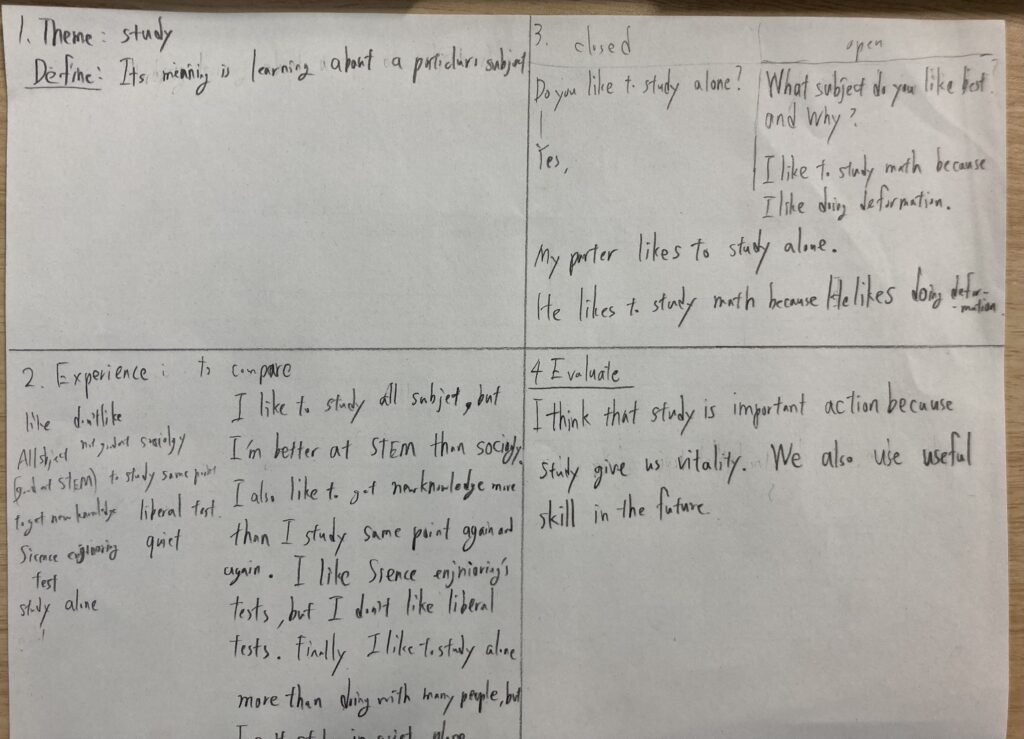
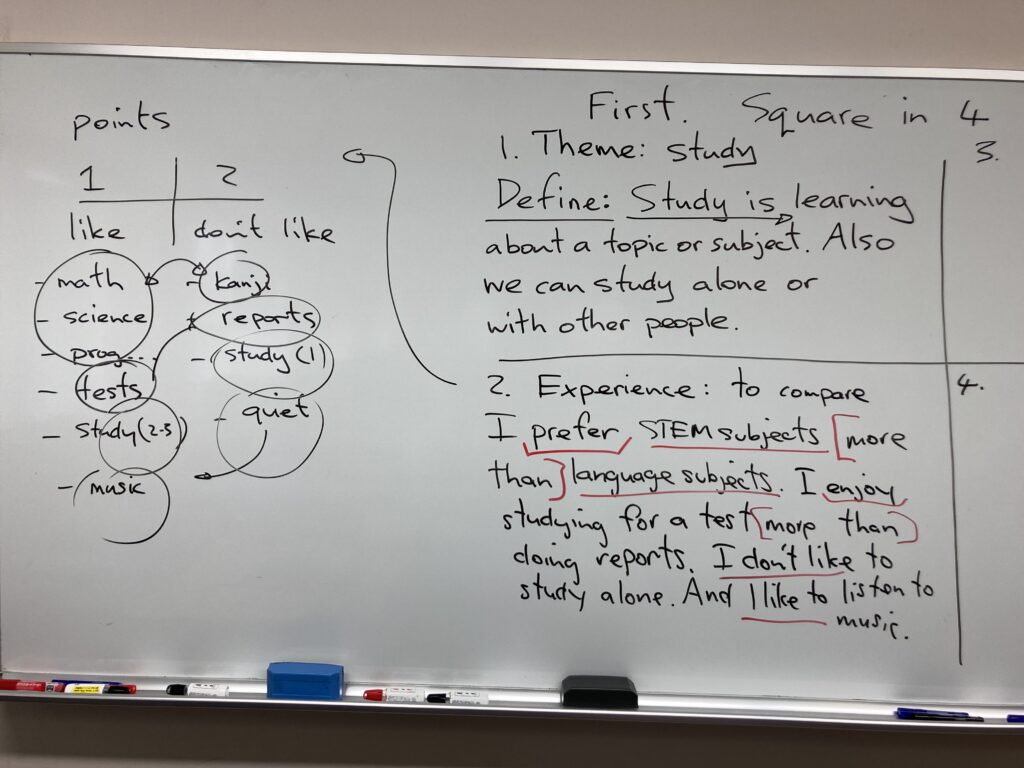
Task 1: Self Introduction

  • name
  • hometown
  • interest / hobby
  • sports / music / free time

Hello. My name is Simon Townsend. Please call me Simon. My hometown is Brisbane City. But now I live in Hachimantai City. I am interested in cooking Italian food. I also like playing sports. In summer I like to go hiking because I like nature. In my free time I enjoy meeting friends and taking onsen.

Task 2: Part-time job

There are many kinds of part-time jobs for university students. Some students work in cloths stores, ramen shops, Juku teacher (private school), and so on…

Q. Do you think students should have a part-time job?

  • write two good points
  • write two bad points

A. I have two good points and two bad points about working a part-time job. First, the good points are… Next, the bad points are… In conclusion, I think [ its good for students / not good / both good and bad ] because…

Task 3: In your groups; make a list of 7 part-time jobs for university students; Next step – rank from 1 to 7. Number 1 is the best job, the second best job is (2) …. and so on.

  • Juku teacher
  • 2
  • 3
  • 4
  • 5
  • 6
  • 7

Task 4 Title: to compare

  • Now think about the good points / bad points of the top 3 jobs on your list
  • two good points for each job
  • two bad points for each job

Task 5 / 6 >>> communication blog