The title of this Table is “Vacation Days per Year” per=every
Short Description: reading left to right; 1) The left side has 8 countries, 2) From there there is information in order starting with Average =====employees give, next Average =====employee takes, and finally 3) Not used days.
Detail (Line 1): In Brazil they have an average of 30days vacation (1), they take an average of 30 days (2), and there are no days left (3).
Line (2-8): … write the details for every country.
Results (the groups and details) (Task 4)
Task activity: select countries and write the sentences
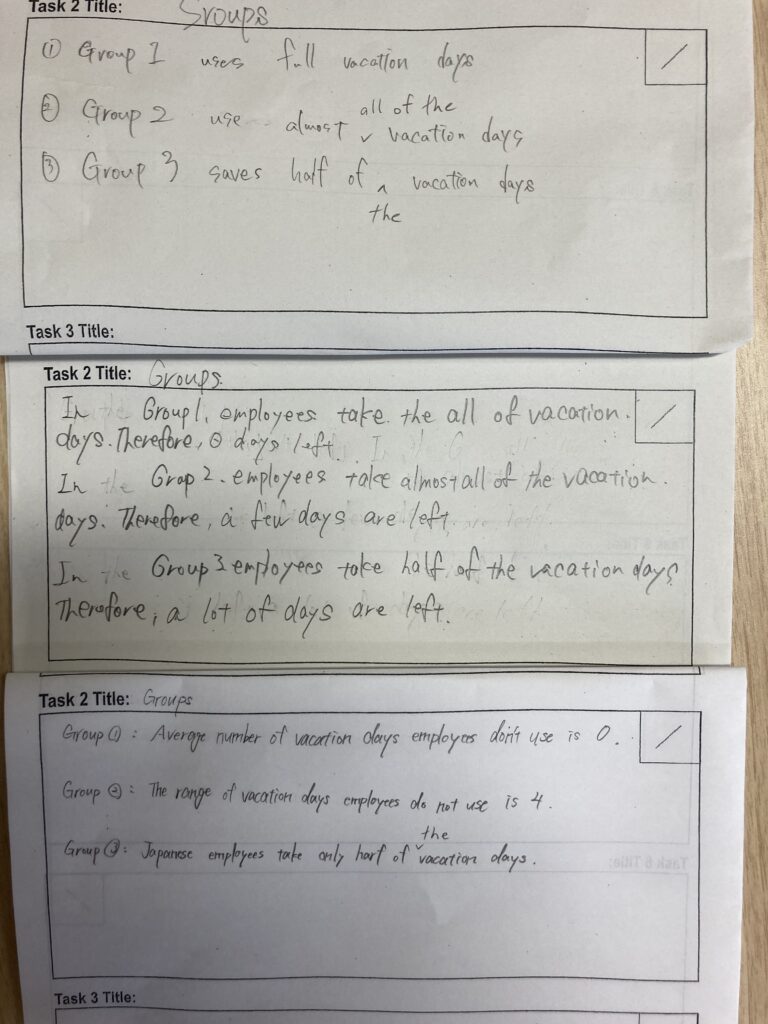
Task 2 Title: Evaluation: groups / grouping method
Step 1: decide the result – what is the result?
Step 2: what groups can you see – think about it?
Step 3: make the groups [***Hint – there are three groups of countries]
Teacher example:
In group 1 / For group 1 : there are no days vacation left. These countries include Brazil, Canada and France.
In group 2 / For group 2 : there are a few days vacation left. There are four countries and they are Malaysia, Mexico, UK and the US. The days left are between 1 to 4 days.
In group 3 / For group 3 : there are a lot of days vacation left. There is only one country Japan [ and they only take half the numbers of days vacation / and take 10 days only vacation ]
Student Example:
Task 3 Title: Japan’s work-culture. Why do Japanese people (employees) only use 10 or half of the days vacation? Please write your answer (40-45words).
Note Section: Do you think foreigners want to work in Japan? a) Yes, b) No, c) Maybe
Please write your response!
HOMEWORK
Finish Task 3 (count the words)
Task 4 Title. Western Culture verse (to compare: same or different) Eastern Culture (video)
What is the same? What is different? [use the before Task: lesson 7 link – language; religion; cuisine; social habits; music and arts (40-55words)
Step 4: Reading Comprehensive exercise. Read the passage and choose the correct answer.
1. Why does the warehouse bring the shelf to the worker instead of having the worker walk to the shelf?
A. It makes the process much quicker and easier. B. Workers are not allowed to move around the warehouse. C. It is required by building safety codes. D. The shelves are too heavy for workers to move.
2. What role do robotics play in the warehouse processes described in the text?
A. They act as a tool to aid humans in meeting increasing customer demand. B. They package items using only human labor. C. They have reduced the number of orders processed weekly. D. They replace the need for receiving goods from trucks.
3. According to the text, what significant development occurred in the last few years regarding warehouse automation?
A. Manual warehouses no longer exist in the UK. B. Automated warehouses are now meaningfully more efficient than human warehouses. C. Automated warehouses have become less efficient than human warehouses. D. Robotics in warehouses have been banned in most fulfillment centers.
4. Why is Amazon’s technology considered a ‘competitive moat’?
A. Other retailers have no technology. B. It prevents Amazon from expanding internationally. C. It lowers the number of orders shipped each week. D. It is technology uniquely invented by Amazon that provides a competitive advantage.
Step 5: Short Answer exercise Read the passage and answer the questions with short responses (sentences).
Q1. How does the shelving system in this warehouse differ from traditional warehouses?
Q2. What role do robotics play in this automated warehouse?
Q3. What recent milestone [achievement] is mentioned regarding automated warehouses?
Q4. How has Amazon maintained a competitive advantage with its fulfillment centers?
The first time. What is your impression – class activity.
Next. What is the theme of this video? (write 20-30 words)
Let’s share with the class. How many themes are there?
Communication with people from all over the world
A man dancing with others
Learning about culture
we can communicate through dance (no speaking)
We can learn about icons / images / famous places – around the world
Activity 2: Theme [Task 2 Title: Observing]
Observing people: what can we learn about observing others? We can observe and learn a lot of ideas. Select one part of the video for a writing activity and write your ideas (5 ideas). Research the internet to find more information.
places
other people: race / nationality; fashion / actions / movements
moments (place and time)
we can think about the situation (theme)
we can get an opinion (what we think)
Teacher Example:
places: I selected a place in Fiji called Wainivilalase. There are 1000 people in this village
other people: These people are Fijian; fBecause they are not rich people they ofent wear very casual clothes. They are famous for being happy and peaceful
moments (place and time): In this moment the kids are enjoying the foriegner visiting their island
theme: I think that the people in this video can share and enjoy by dancing together.
opinion: I think that these people (Fijian’s) are friendly and very happy to meet people visiting their village (place)
Technique: Is asking follow up questions (3b)
Q. Do you want to travel to there? If yes – why? If no – Where do you want to travel to in the future?
Q. Why do you think…. [these people are friendly or happy] ?
Q. If you want to go there… what other things do you want to do?
Task 3 Title: Reflection
Lesson 2 and 3: How is this lesson for you? Can you learn English? good points… or are there any bad points?
Aim: To learn about robotics and use the 2 basic writing skills (1. paraphrasing and 2. summarizing), and using dictionaries.
Activities: These activities are skills based. We are going to do a) individual and b) pair / small group activities
Lets start!
Task 4 Title: Paraphrasing Information
Skill 1: Paraphrasing the video in class and read the passage. How many Main points can you identify? Complete the exercises;
Exercise: Make a list of the main points; MP1: There are two main processes; MP2: First items arrive (come) to the warehouse; MP3 Items are delivered and assigned; MP4
Exercise: Write a description of the main points
Exercise: Write the key words for each main point
HOMEWORK
Task 5 Title: Summarising Information (Amazon Video)
Skill 2: Summarising the video and passage. Write a short 40-50/60 word Summary of the topic
TEMPLATE:
This video is about [ … ]. There are several main points. These are [write MP1], [MP 2], and [last MP].
Aim: To learn about robotics and use the 4 basic reading skills (1. previewing, 2. predicting, 3. skimming, and 4. scanning)
Activities: These activities are skills based. We are going to do a) individual and b) pair / small group activities
Lets start!
Warm Up Activity
Skill 1: Preview the video in class. Watch the video. Then answer the question below (write 20 words)
Question: What is the video about?
Step 1: Read video transcript and watch and listen – repeat
Task 3 Title: Language and Information
Skill 2: Predicting the key words (important words or phrases) and complete the exercises:
Exercise: Write a list of key words (5-10 words); two main processes [1] items are unloaded [2]
Exercise: Do you have (GW) General Words / (E) Engineering OR (R)obot words?
Exercise: Write the meaning for some words (3-5 words)
0:03 And then on this floor, we’ve got two main processes. So, one is to stow items that are just been received into the
0:11 warehouse. So, we receive them on the ground floor downstairs where the items are unloaded from a truck. They’re put into one of these many black totes,
0:19 moved around the building to a stow station, and very simply in a normal warehouse environment, you you have to
0:27 walk to a shelf, and this does the reverse. The shelf comes to you. So, it makes it much quicker, much easier. This
0:33 is a very highly automated robotic warehouse. We process millions of orders a week through this particular building
0:41 alone, which is one of over 30 within our UK network. Each of the orders that gets assigned to this building gets picked, packed, and shipped in less than two hours.
0:51 I think robotics is here to help us, and it’s a tool to aid us. The customer demand is forever increasing, and we’re getting the parcels out the door faster
1:00 than ever, and that’s what the robotics are here to help us with.
1:04 Only in the last few years have we really passed this inflection point where the automated warehouses are meaningfully more efficient than the
1:12 human warehouses. And so today the the Amazon fulfillment centers that are automated are are amongst the most efficient fulfillment centers in the
1:20 world. Amazon has invented a lot of its own technology uh to do that. Um and that has been a bit of a a competitive
1:27 moat for Amazon. But there are a lot of smart entrepreneurs that have developed alternative systems that other retailers are using.
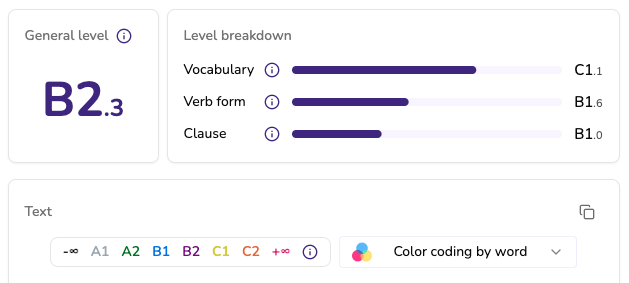
Step 2: Read the color coded transcript
Skill 3: Skimming the words “color coding” and check the following;
Exercise: Check the level of the words.
Exercise: What was the level of your words in “step 1” and make a note* example A2 or B2
Skill 4: Scanning and reading the passage. Do you understand the passage more than before? Check the words you do not know.
And then on this floor, we’ve got two main processes. So, one is to stow items that are just been received into the warehouse. So, we receive them on the ground floor downstairs where the items are unloaded from a truck. They’re put into one of these many black totes, moved around the building to a stow station, and very simply in a normal warehouse environment, you you have to walk to a shelf, and this does the reverse. The shelf comes to you. So, it makes it much quicker, much easier. This is a very highly automated robotic warehouse. We process millions of orders a week through this particular building alone, which is one of over 30 within our UK network. Each of the orders that gets assigned to this building gets picked, packed, and shipped in less than two hours. I think robotics is here to help us, and it’s a tool to aid us. The customer demand is forever increasing, and we’re getting the parcels out the door faster than ever, and that’s what the robotics are here to help us with. Only in the last few years have we really passed this inflection point where the automated warehouses are meaningfully more efficient than the human warehouses. And so today the the Amazon fullfillment centres that are automated are are amongst the most efficient fullfillment centres in the world. Amazon has invented a lot of its own technology uh to do that. Um and that has been a bit of a a competitive moat for Amazon. But there are a lot of smart entrepreneurs that have developed alternative systems that other retailers are using.
Step 4: Reading Comprehensive exercise. Read the passage and choose the correct answer.
1. Why does the warehouse bring the shelf to the worker instead of having the worker walk to the shelf?
A. It makes the process much quicker and easier. B. Workers are not allowed to move around the warehouse. C. It is required by building safety codes. D. The shelves are too heavy for workers to move.
2. What role do robotics play in the warehouse processes described in the text?
A. They act as a tool to aid humans in meeting increasing customer demand. B. They package items using only human labor. C. They have reduced the number of orders processed weekly. D. They replace the need for receiving goods from trucks.
3. According to the text, what significant development occurred in the last few years regarding warehouse automation?
A. Manual warehouses no longer exist in the UK. B. Automated warehouses are now meaningfully more efficient than human warehouses. C. Automated warehouses have become less efficient than human warehouses. D. Robotics in warehouses have been banned in most fulfillment centers.
4. Why is Amazon’s technology considered a ‘competitive moat’?
A. Other retailers have no technology. B. It prevents Amazon from expanding internationally. C. It lowers the number of orders shipped each week. D. It is technology uniquely invented by Amazon that provides a competitive advantage.
Step 5: Short Answer exercise Read the passage and answer the questions with short responses (sentences).
1. How does the shelving system in this warehouse differ from traditional warehouses?
2. What role do robotics play in this automated warehouse?
3. What recent milestone is mentioned regarding automated warehouses?
4. How has Amazon maintained a competitive advantage with its fulfillment centers?