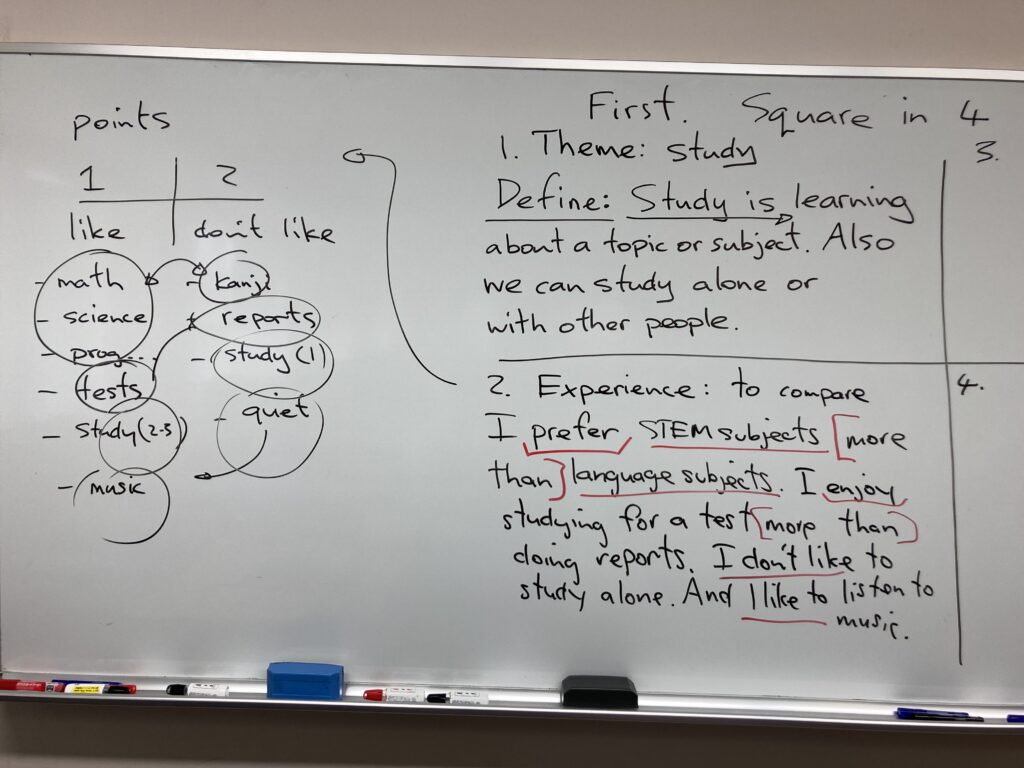
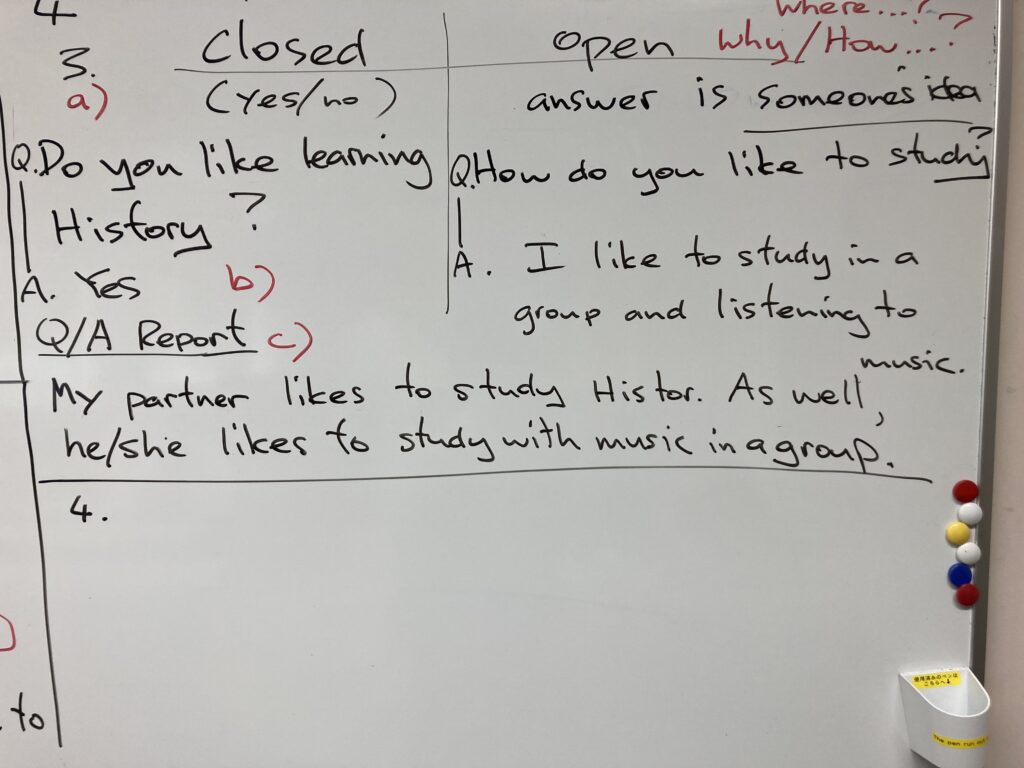
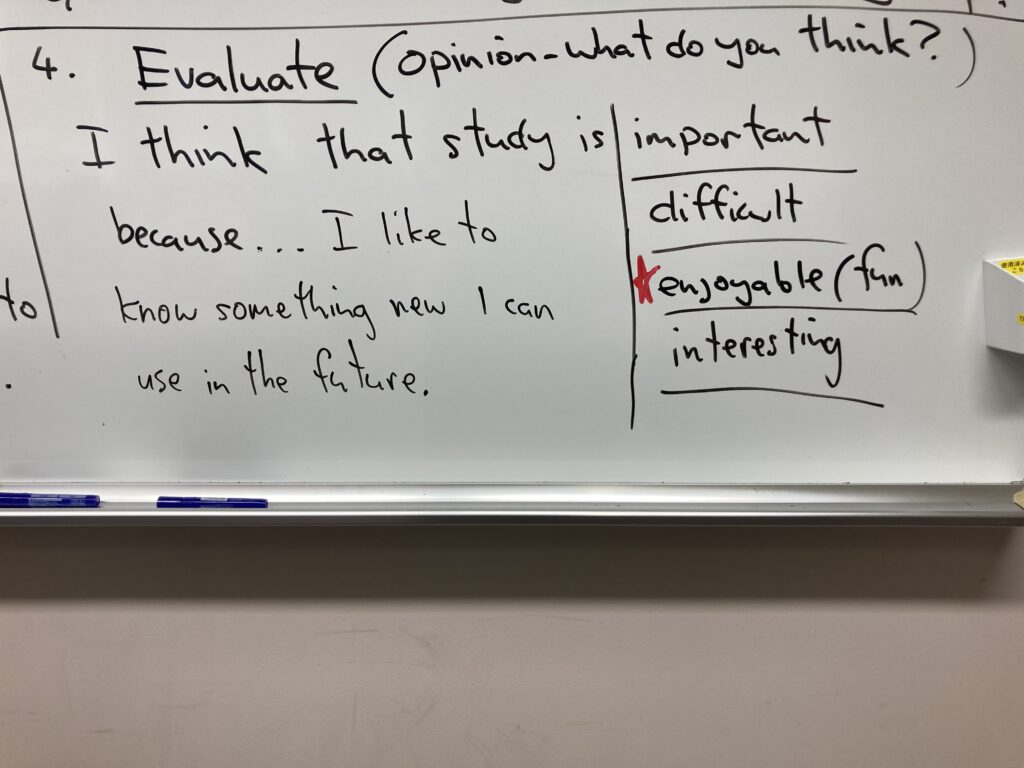
June 12th – lesson 8

June 12th Aim: To read Tables and graphs

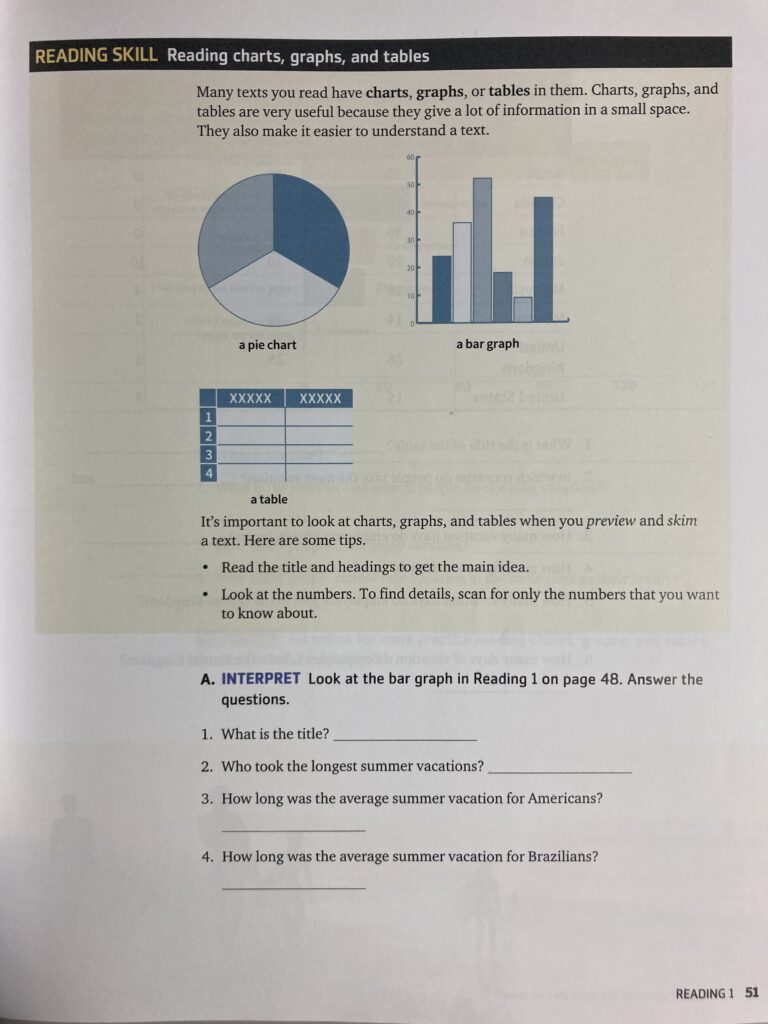
Task 1 Title. Reading a Table

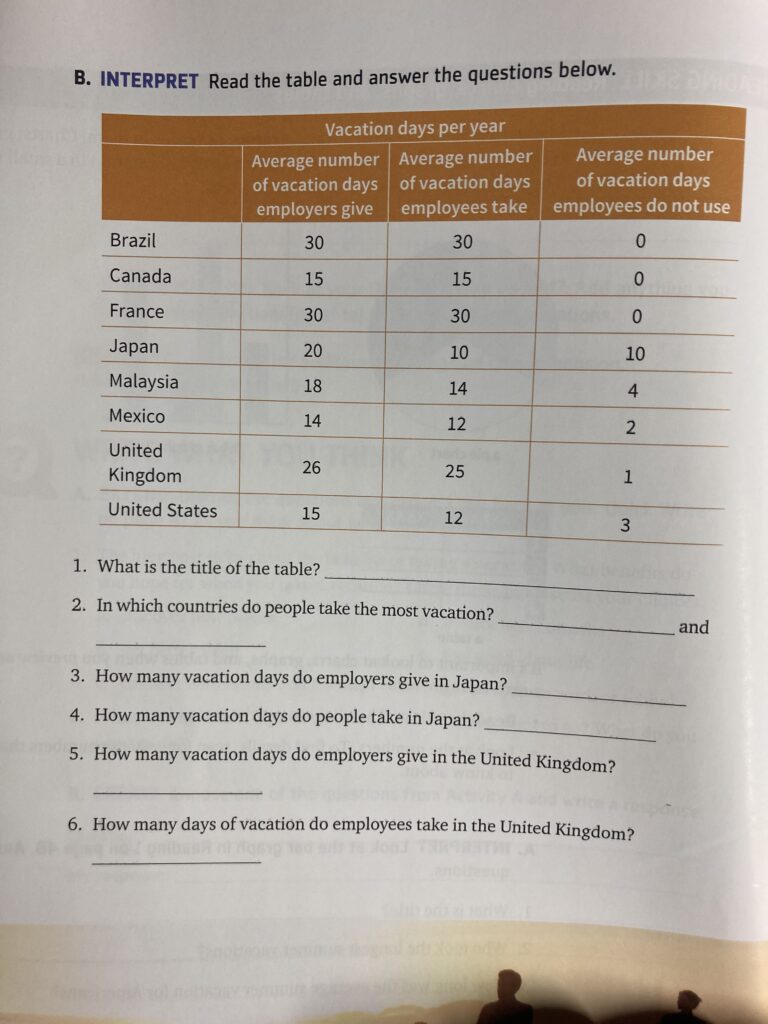
  1. The title of this Table is “Vacation Days per Year” per=every
  2. Short Description: reading left to right; 1) The left side has 8 countries, 2) From there there is information in order starting with Average =====employees give, next Average =====employee takes, and finally 3) Not used days.
  3. Detail (Line 1): In Brazil they have an average of 30days vacation (1), they take an average of 30 days (2), and there are no days left (3).
  4. Line (2-8): … write the details for every country.
  5. Results (the groups and details) (Task 4)

Task activity: select countries and write the sentences

Task 2 Title: Evaluation: groups / grouping method

  • Step 1: decide the result – what is the result?
  • Step 2: what groups can you see – think about it?
  • Step 3: make the groups [***Hint – there are three groups of countries]

Teacher example:

  • In group 1 / For group 1 : there are no days vacation left. These countries include Brazil, Canada and France.
  • In group 2 / For group 2 : there are a few days vacation left. There are four countries and they are Malaysia, Mexico, UK and the US. The days left are between 1 to 4 days.
  • In group 3 / For group 3 : there are a lot of days vacation left. There is only one country Japan [ and they only take half the numbers of days vacation / and take 10 days only vacation ]

Student Example:
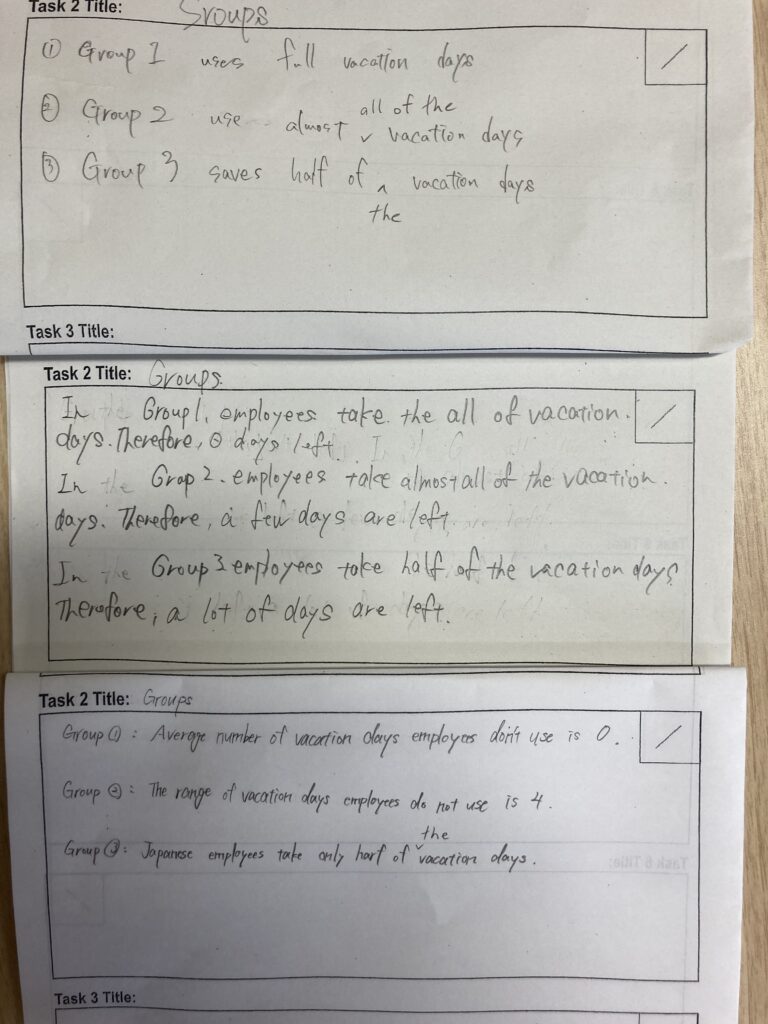
Task 3 Title: Japan’s work-culture. Why do Japanese people (employees) only use 10 or half of the days vacation? Please write your answer (40-45words).

Note Section: Do you think foreigners want to work in Japan? a) Yes, b) No, c) Maybe

Please write your response!

HOMEWORK

  • Finish Task 3 (count the words)
  • Task 4 Title. Western Culture verse (to compare: same or different) Eastern Culture (video)
  • What is the same? What is different? [use the before Task: lesson 7 link – language; religion; cuisine; social habits; music and arts (40-55words)
  • Saturday Quiz from 9am.

June 5th-12th – Culture

Aim1: To think about culture in Japan and another country;

Task 4 Title: Culture (a) Japan / (b) __________ [select a country]

Task 5 Title: Explain your hometown – 4 squares

  1. Name of City/Town & Prefecture & Population (how many people) / Size (how big)
  2. Famous 1: … (20words)
  3. Famous 2: … (20words)
  4. Tell a foreigner why they should visit your hometown (25-30words)

Teacher example: As I mentioned [famous 1] is …. In addition [famous 2] is … In my opinion …

Reading Activity: number (1) and number (4)

Task 6 Title: Reflection: What ranking is Japan on the world travel list? Japan is No.1 What do you think? Why?

Homework: watch the video and take notes – A4 Paper / Campus Paper

  • vocabulary
  • expressions (short sentences)
  • main points

Video link

============================================================

JUNE 12th Lesson

Objective: To learn important points about the video; compare Mexico with Japan – Mexican culture and Japanese culture

Task 1. Point (a) / Point (b)

Task 2. Point (c) / Point (d)

Task 3. Point (e)

Student example:

Task 4. Mexican culture and Japanese culture (a)

  1. language: In Mexico they speak Spanish, and in Japan they speak Japanese
  2. religion:
  3. cuisine:
  4. social habits:
  5. music and arts:

Homework:

Lesson 7/8/9 – June2/9/16 Unit 3

Vacations

HOMEWORK

  • quiz 4 (Saturday 9am – before the next class)(in class)
  • p46. A. / B.
  • p47-48. Reading: Managing Life and Work; take notes; learn the key words / phrases / main points

Task 6 Title: Free writing (Unit 3 warm-up): Question Where do you want to travel in Japan or Abroad? Where and why?

  • Upload Unit 2 worksheet and notes (in class) – Moodle Link

Task 1: Title p.49 C Identify (Shikibetstu – 識別する)

  1. Pro / Pros = positive points / good things (experiences)
  2. Con / Cons = negative points / not good (experiences)

Sentence examples:

1.[No.3] Pro: more creative when they come home – why? discover different ways people live – interesting — people feel creative in their thinking / better at solving problems

  • One of the pros for [long / short vacations] is that people …
  • One [positive experience / good point] for [long / short vacations] is that people …

2.[No.4] Con: people do not sleep well – why?

  • One of the cons for [long / short vacations] is that people …
  • One [negative experience / bad point] for [long / short vacations] is that people …

Task 2. Title: Sentences; finish for homework

  • write 2 example sentences for long vacation
  • 1 Pro
  • 1 Con
  • write 2 example sentences for short vacation
  • 1 Pro
  • 1 Con

Homework

  • Task 2 finish
  • Task 3. Title: p52. B (1-6) Look at the Table and do the exercise
  • Quiz 5 – Saturday 9am –> (remember to log out after the quiz)

June 9th Aim: To read Tables and graphs

Task 3 Title. Reading a Table

  1. The title of this Table is “Vacation Days per Year” per=every
  2. Short Description: reading left to right; 1) The left side has 8 countries, 2) From there there is information in order starting with Average =====employees give, next Average =====employee takes, and finally 3) Not used days.
  3. Detail (Line 1): In Brazil they have an average of 30days vacation (1), they take an average of 30 days (2), and there are no days left (3).
  4. Line (2-8): … write the details for every country.
  5. Results (the groups and details) (Task 4)

Task 3 activity: select countries and write the sentences

Task 4 Title: Evaluation: groups / grouping method

  • Step 1: decide the result – what is the result?
  • Step 2: what groups can you see – think about it?
  • Step 3: make the groups [***Hint – there are three groups of countries]

Teacher example:

  • In group 1 / For group 1 : there are no days vacation left. These countries include Brazil, Canada and France.
  • In group 2 / For group 2 : there are a few days vacation left. There are four countries and they are Malaysia, Mexico, UK and the US. The days left are between 1 to 4 days.
  • In group 3 / For group 3 : there are a lot of days vacation left. There is only one country Japan [ and they only take half the numbers of days vacation / and take 10 days only vacation ]

Task 5/6 Title Table Report please write the whole report for Brazil, Canada, Japan, Malaysia, and Mexico.

HOMEWORK

  • Finish Task 5/6
  • Quiz 6

June 15

Activity continue: Graphs

Reflection (Note section)

Summary: What did we learn?

  • FOI (facts of information)
  • sources are: internet, journals, magazines, textbooks, … (where we get information from)
  • tables / graphs: there is a lot of information / helpful to understand a topic
  • American Standard for writing paragraphs; Topic sentence (1); Support sentences (ideas)(2-3-4); to finish we use a Conclusion sentence (usually a shorter sentence)(5)

Question: What is your best summer vacation? Answer with the American Standard (1-2-3-4-5)

HOMEWORK

  • Read the next topic: p.73-74 (30-45minutes)
  • check the language; key words (topic words); phrases; main ideas
  • use A4 paper / Campus paper
  • Saturday quiz – No7.

***this topic is “Physiology” check the meaning?

Friday – May 22

Aim: To practice your speech in small groups; improve your speech; and present

Checklist: follow these steps, in any order, as many times as you want to (repeat these steps)

  • check your time – read at a normal speed
  • editing – sometimes we need to add words or a sentence / deleting words or sentences

Speech Preparation: to present it is important to use your speech card as a tool for speaking. This is not a reading exercise.

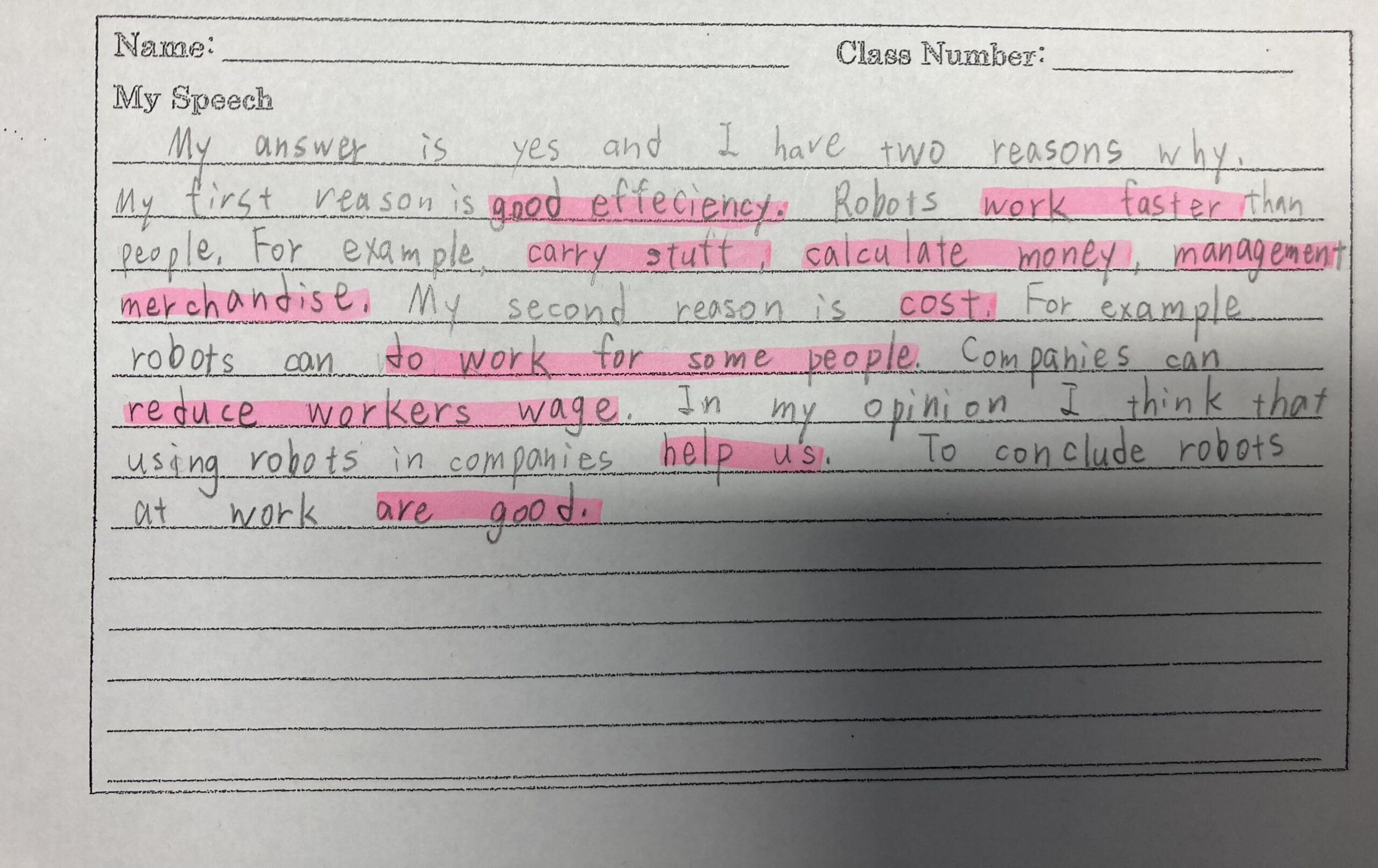
  • Highlight the key words / phrases (about 10-12)
  • Read – Look Up & Speak the highlighted text
  • You do not have to memorize your speech

Student Example:

  • Important name / company name / persons name (animal name) / country name
  • Main point [1] and main point [2] – key word(s) / support sentences (key words): numbers / date-year / …
  • Opinion key word(s)
  • Conclusion key word(s)

Topic: Robots – Q. Do you think robots at work are good or not? Yes / No

Steps: follow these steps;

  1. My answer is [yes/no] and I have two reasons why.
  2. My first reason is … [Main Point number 1]
  3. For example …
  4. My second reason is … [Main Point number 2]
  5. For example …
  6. In my opinion I think that …
  7. To conclude [finish sentence] …

火曜日Lesson 5/6 – May 19/26

May 12 HOMEWORK

  1. Title: The Brain and Technology p.32/33. Please study this passage. Learn the vocab (words) and natural expressions (sentences). Bring your notes to class.
  2. Quiz : Open Saturday 9am

Sogo 2

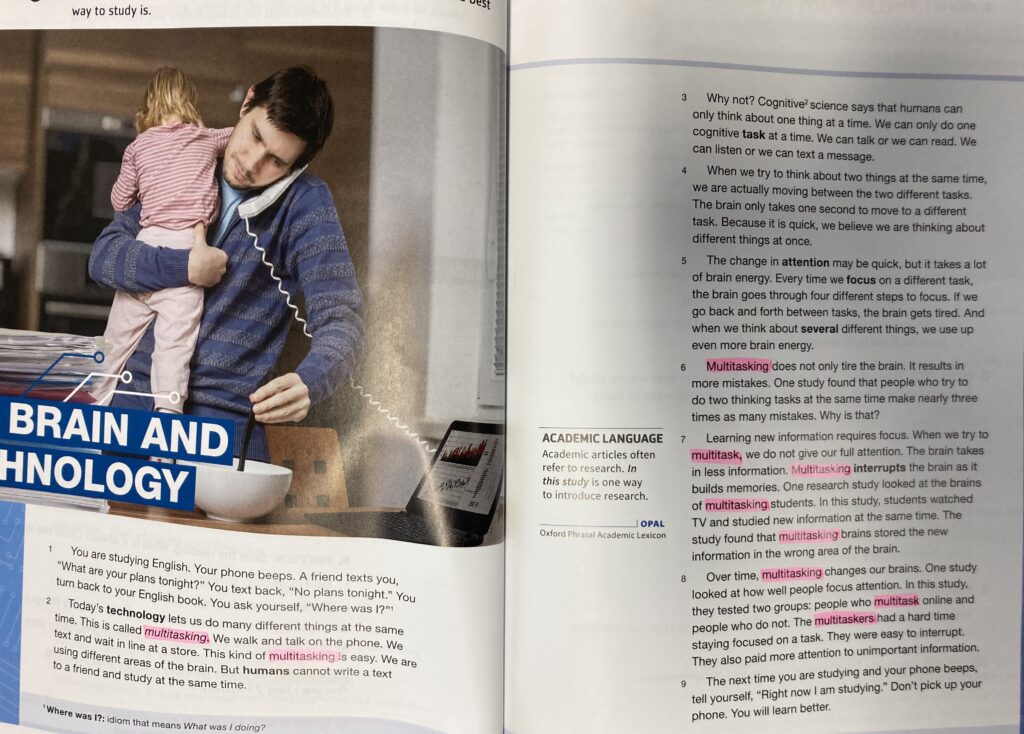
Task 1 Title: Multitasking

  • highlight every sentence with “multitasking”
  • please write the definition [2] line 4/5 “Today’s technology lets us do many things at the same time. This is called multitasking.”
  • please write every sentence with multitasking

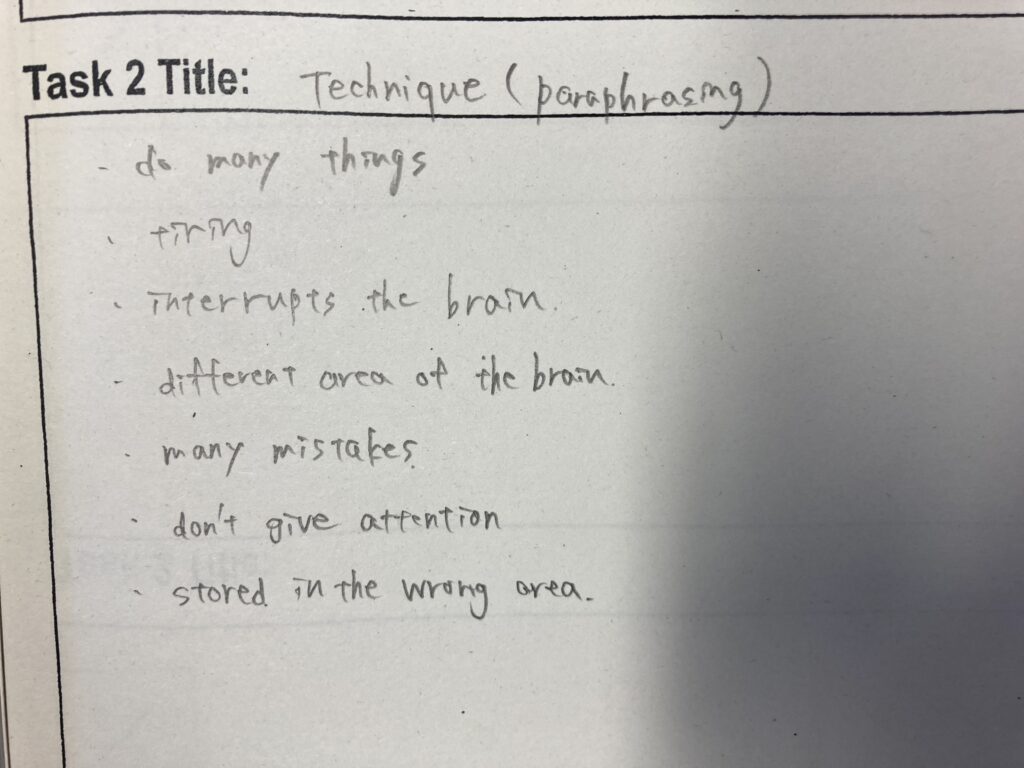
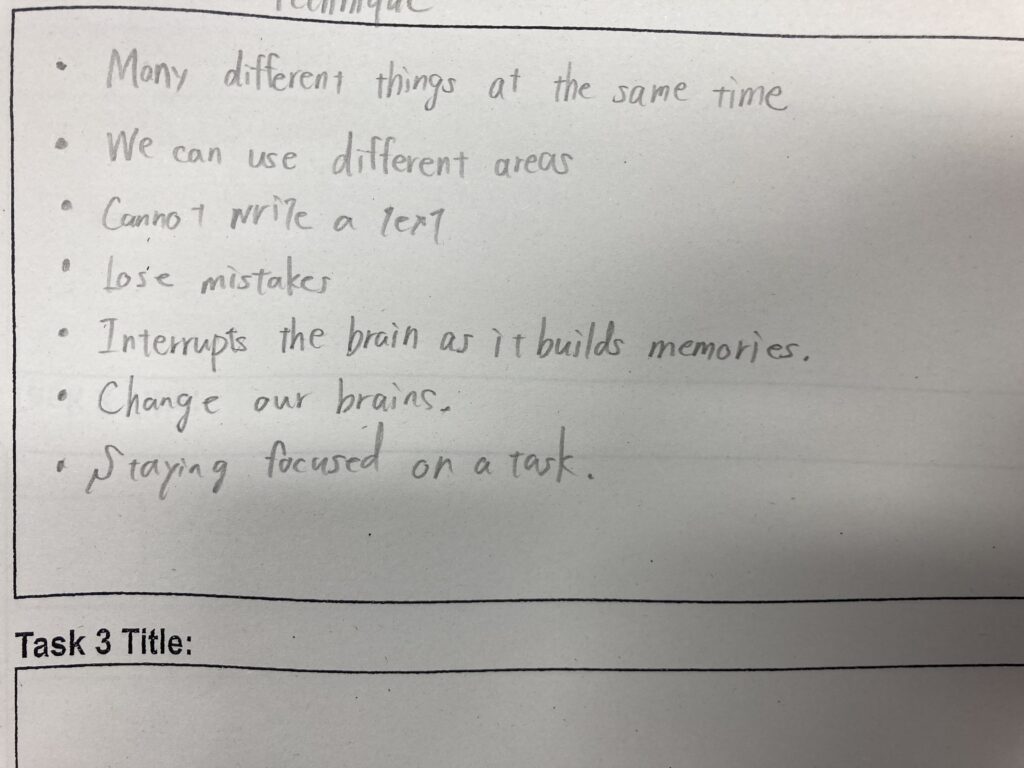
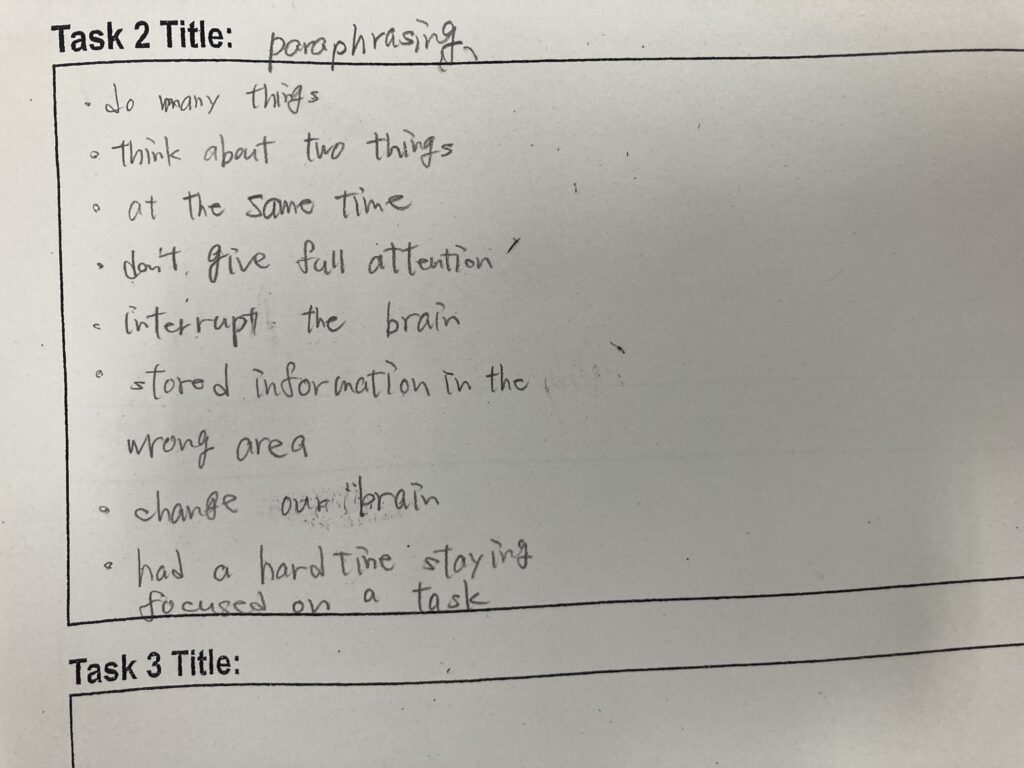
Task 2 Title: Technique [paraphrasing]

What is paraphrasing? We check a paragraph (text) / We check long sentences and change into short sentences called phrases (paraphrasing). For example: In a PowerPoint presentation we often use these phrases (bullet points).

Teacher example: multitasking

  • do many things
  • tiring
  • interrupts the brain

Student examples:

HOMEWORK

  • Task 3 Title: Can you multitask? a) yes; b) no; or c) sometimes (50-60words)
  • Quiz 3
  • May 12 activity speech card – please bring to the next class.

speech card example:

Activity: Preparing a response: (B) p.36

Steps:With your partner; select No.1 or No.2 (same)

  1. What is better for your brain? Study a little bit everyday (option a); Study a lot at one time (option b); OR (option a and b)

Activity: Preparing a response: (B) p.36

Task 4 Title: What is your answer and why? Write as much as you can (10minutes)

Grammar Activity: “but” and “so” (A/B) p.38

  1. So – when the second sentence is the result of sentence 1
  2. But – has opposite / different information than you think
  • I didn’t eat lunch, so I am hungry now.
  • I didn’t eat lunch, but I am surprised that I am not hungry.

***Note: we can express ourself easily using these sentences. Also we can explain something easily and people understand what we mean.

Task 5 Title: Reflect (D) No.1

  • Reading 2: Multi-tasking – p32-33
  • What did you learn about this topic (theme)?
  • What changes do you want to make about your own study?
  • What do you recommend as the best way to study for a test?

Hints:

  1. there is no right / wrong answer
  2. use some of the words (topic / key words) from the reading
  3. of course use the grammar [so/but] to express yourself

Robot Passage Questions

Step 4: Reading Comprehensive exercise. Read the passage and choose the correct answer.

1.  Why does the warehouse bring the shelf to the worker instead of having the worker walk to the shelf?

A. It makes the process much quicker and easier.
B. Workers are not allowed to move around the warehouse.
C. It is required by building safety codes.
D. The shelves are too heavy for workers to move.

2.  What role do robotics play in the warehouse processes described in the text?

A. They act as a tool to aid humans in meeting increasing customer demand.
B. They package items using only human labor.
C. They have reduced the number of orders processed weekly.
D. They replace the need for receiving goods from trucks.

3.  According to the text, what significant development occurred in the last few years regarding warehouse automation?

A. Manual warehouses no longer exist in the UK.
B. Automated warehouses are now meaningfully more efficient than human warehouses.
C. Automated warehouses have become less efficient than human warehouses.
D. Robotics in warehouses have been banned in most fulfillment centers.

4.  Why is Amazon’s technology considered a ‘competitive moat’?

A. Other retailers have no technology.
B. It prevents Amazon from expanding internationally.
C. It lowers the number of orders shipped each week.
D. It is technology uniquely invented by Amazon that provides a competitive advantage.

Step 5: Short Answer exercise Read the passage and answer the questions with short responses (sentences).

  • Q1. How does the shelving system in this warehouse differ from traditional warehouses?
  • Q2. What role do robotics play in this automated warehouse?
  • Q3. What recent milestone [achievement] is mentioned regarding automated warehouses?
  • Q4. How has Amazon maintained a competitive advantage with its fulfillment centers?

L3b – May 1

Activity 1: Theme [Task 1 Title: Video theme]

  • The first time. What is your impression – class activity.
  • Next. What is the theme of this video? (write 20-30 words)

Let’s share with the class. How many themes are there?

  1. Communication with people from all over the world
  2. A man dancing with others
  3. Learning about culture
  4. we can communicate through dance (no speaking)
  5. We can learn about icons / images / famous places – around the world

Activity 2: Theme [Task 2 Title: Observing]

Observing people: what can we learn about observing others? We can observe and learn a lot of ideas. Select one part of the video for a writing activity and write your ideas (5 ideas). Research the internet to find more information.

  1. places
  2. other people: race / nationality; fashion / actions / movements
  3. moments (place and time)
  4. we can think about the situation (theme)
  5. we can get an opinion (what we think)

Teacher Example:

  1. places: I selected a place in Fiji called Wainivilalase. There are 1000 people in this village
  2. other people: These people are Fijian; fBecause they are not rich people they ofent wear very casual clothes. They are famous for being happy and peaceful
  3. moments (place and time): In this moment the kids are enjoying the foriegner visiting their island
  4. theme: I think that the people in this video can share and enjoy by dancing together.
  5. opinion: I think that these people (Fijian’s) are friendly and very happy to meet people visiting their village (place)

Technique: Is asking follow up questions (3b)

Q. Do you want to travel to there? If yes – why? If no – Where do you want to travel to in the future?

Q. Why do you think…. [these people are friendly or happy] ?

Q. If you want to go there… what other things do you want to do?

Task 3 Title: Reflection

Lesson 2 and 3: How is this lesson for you? Can you learn English? good points… or are there any bad points?