Aim: To learn about robotics and use the 4 basic reading skills (1. previewing, 2. predicting, 3. skimming, and 4. scanning)
Activities: These activities are skills based. We are going to do a) individual and b) pair / small group activities
Lets start!
Warm Up Activity
Skill 1: Preview the video in class. Watch the video. Then answer the question below (write 20 words)
Question: What is the video about?
Step 1: Read video transcript and watch and listen – repeat
Task 3 Title: Language and Information
Skill 2: Predicting the key words (important words or phrases) and complete the exercises:
- Exercise: Write a list of key words (5-10 words); two main processes [1] items are unloaded [2]
- Exercise: Do you have (GW) General Words / (E) Engineering OR (R)obot words?
- Exercise: Write the meaning for some words (3-5 words)
0:03 And then on this floor, we’ve got two main processes. So, one is to stow items that are just been received into the
0:11 warehouse. So, we receive them on the ground floor downstairs where the items are unloaded from a truck. They’re put into one of these many black totes,
0:19 moved around the building to a stow station, and very simply in a normal warehouse environment, you you have to
0:27 walk to a shelf, and this does the reverse. The shelf comes to you. So, it makes it much quicker, much easier. This
0:33 is a very highly automated robotic warehouse. We process millions of orders a week through this particular building
0:41 alone, which is one of over 30 within our UK network. Each of the orders that gets assigned to this building gets picked, packed, and shipped in less than two hours.
0:51 I think robotics is here to help us, and it’s a tool to aid us. The customer demand is forever increasing, and we’re getting the parcels out the door faster
1:00 than ever, and that’s what the robotics are here to help us with.
1:04 Only in the last few years have we really passed this inflection point where the automated warehouses are meaningfully more efficient than the
1:12 human warehouses. And so today the the Amazon fulfillment centers that are automated are are amongst the most efficient fulfillment centers in the
1:20 world. Amazon has invented a lot of its own technology uh to do that. Um and that has been a bit of a a competitive
1:27 moat for Amazon. But there are a lot of smart entrepreneurs that have developed alternative systems that other retailers are using.
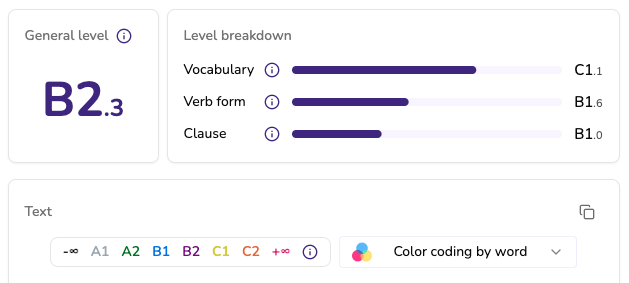
Step 2: Read the color coded transcript
Skill 3: Skimming the words “color coding” and check the following;
- Exercise: Check the level of the words.
- Exercise: What was the level of your words in “step 1” and make a note* example A2 or B2
- Repeat Skill 2 and Skill 3 in a teachers activity
Step 3: Read the full paragraph
Skill 4: Scanning and reading the passage. Do you understand the passage more than before? Check the words you do not know.
And then on this floor, we’ve got two main processes. So, one is to stow items that are just been received into the warehouse. So, we receive them on the ground floor downstairs where the items are unloaded from a truck. They’re put into one of these many black totes, moved around the building to a stow station, and very simply in a normal warehouse environment, you you have to walk to a shelf, and this does the reverse. The shelf comes to you. So, it makes it much quicker, much easier. This is a very highly automated robotic warehouse. We process millions of orders a week through this particular building alone, which is one of over 30 within our UK network. Each of the orders that gets assigned to this building gets picked, packed, and shipped in less than two hours. I think robotics is here to help us, and it’s a tool to aid us. The customer demand is forever increasing, and we’re getting the parcels out the door faster than ever, and that’s what the robotics are here to help us with. Only in the last few years have we really passed this inflection point where the automated warehouses are meaningfully more efficient than the human warehouses. And so today the the Amazon fullfillment centres that are automated are are amongst the most efficient fullfillment centres in the world. Amazon has invented a lot of its own technology uh to do that. Um and that has been a bit of a a competitive moat for Amazon. But there are a lot of smart entrepreneurs that have developed alternative systems that other retailers are using.
Step 4: Reading Comprehensive exercise. Read the passage and choose the correct answer.
1. Why does the warehouse bring the shelf to the worker instead of having the worker walk to the shelf?
A. It makes the process much quicker and easier.
B. Workers are not allowed to move around the warehouse.
C. It is required by building safety codes.
D. The shelves are too heavy for workers to move.
2. What role do robotics play in the warehouse processes described in the text?
A. They act as a tool to aid humans in meeting increasing customer demand.
B. They package items using only human labor.
C. They have reduced the number of orders processed weekly.
D. They replace the need for receiving goods from trucks.
3. According to the text, what significant development occurred in the last few years regarding warehouse automation?
A. Manual warehouses no longer exist in the UK.
B. Automated warehouses are now meaningfully more efficient than human warehouses.
C. Automated warehouses have become less efficient than human warehouses.
D. Robotics in warehouses have been banned in most fulfillment centers.
4. Why is Amazon’s technology considered a ‘competitive moat’?
A. Other retailers have no technology.
B. It prevents Amazon from expanding internationally.
C. It lowers the number of orders shipped each week.
D. It is technology uniquely invented by Amazon that provides a competitive advantage.
Step 5: Short Answer exercise Read the passage and answer the questions with short responses (sentences).
1. How does the shelving system in this warehouse differ from traditional warehouses?
2. What role do robotics play in this automated warehouse?
3. What recent milestone is mentioned regarding automated warehouses?
4. How has Amazon maintained a competitive advantage with its fulfillment centers?