[0:07]
Human Impact
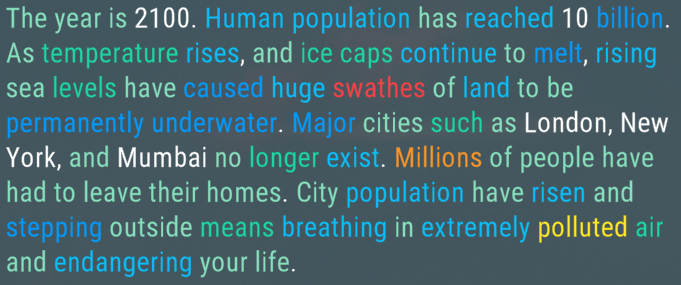
The year is 2100. Human population has reached 10 billion. As temperature rises, and ice caps continue to melt, rising sea levels have caused huge swathes of land to be permanently underwater. Major cities such as London, New York, and Mumbai no longer exist. Millions of people have had to leave their homes. City population have risen and stepping outside means breathing in extremely polluted air and endangering your life. [paragraph 1]
Once fertile farmland has become unworkable as soil turns into dust. The number of people not getting enough food increases. Rivers and seas are polluted. The provision of clean water and ever-increasing problem. This sounds like the plot of a dystopian novel, but it could end up being real. Since the Industrial Revolution in the late 19th century, the human population has exploded, and is now growing at an exponential rate, with no signs of slowing down. More people demand more resources and create more pollution, and ever-increasing impact on Earth. [paragraph 1]
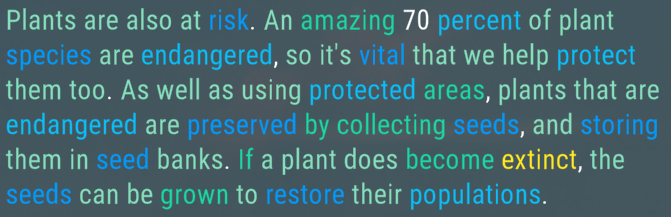
Humans cause pollution by burning fossil fuels. We are relying on them for transport and electricity generation. Burning fossil fuels releases carbon dioxide into the atmosphere, which is a greenhouse gas. Increased greenhouse gases caused an increase in average global temperatures known as the greenhouse effect. This is linked to climate change. Some areas of the world are getting wetter and others hotter and drier, and these changes have an impact on ecosystems and biodiversity. If you want to learn more about biodiversity, and why it matters, watch this video [Biodiversity]. For example, warmer weather in the Arctic, and the subsequent melting of the sea ice, has an effect on animals that living there. The polar bear is no longer well adapted for living in its habitat, and is an endangered species. [paragraph 2]
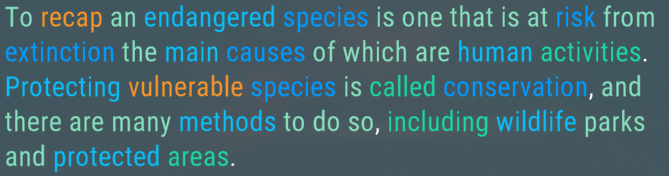
Humans also require resources. Large areas of forests are cleared to make more room for agriculture, also mine minerals or for growing other resources like palm oil. The removal of trees is called deforestation, and has an enormous impact on not only the local ecosystem, but the entire planet. Ancient forests such as rainforests are unique ecosystems. They can support a high biodiversity, and are home to species that can only live in that habitat. For example, in Borneo rainforests are being cut down to make room for palm oil plantations. The species that live in the rainforests cannot survive in the plantations. They may not be able to find food or shelter. Like orangutans, who are an endangered species. You can find out more about endangered species and how conservation is helping them, by watching this [Endangered Animals] video. [paragraph 3]
Forests provide services to the planet. They are important in the water cycle, recycling fresh water across the globe. Trees are also able to take in and store carbon dioxide, which helps regulate the earth’s temperature, as well as burning fossil fuels and deforestation. Humans also create lots of waste sewage, pesticides, and fertilizers enter the water, and may contain toxic substances that can kill organisms, and impact on whole food webs. Pesticides can accumulate in the tissues of organisms, and stay in the environment for many years before being broken down. [paragraph 4]
A combination of a growing population and a throwaway culture. We also have increasing demands for dirty, wasteful landfill. But let’s end on a happier note. There is some hope. People are coming to realize the impact we are having on the environment, and governments are aiming to cut down their reliance on fossil fuels, and put in schemes into place to help protect forests and endangered species. [paragraph 5]
So in this video you’ve learnt about how human activity has a negative impact on the earth because of burning fossil fuels, deforestation and creating waste. [paragraph 5]