Category: Course Details
eBlog
English: With this access code (ae25) you can use the eBlog learning program for approximately 180 days.
日本語: 日本語このアクセス コード (ae25) を使用すると、eBlog 学習プログラムを約 180 日間使用できます。
English: eBlog cost information (eLearning & Homepage): Please pay in class next week 2,500 1,700yen. Please write your name and details on an envelope and give with the money to your teacher. Your teacher will give you a receipt in class later. This is not an eBook.
日本語: eBlogの費用ついて (eラーニング & ホームページ):教材の費用として1人2500 1700円を徴収するのでお金を準備してください。封筒に自分の名前を書き、お金を入れて、サイモン先生に渡してください。授業でレシートを渡します。これは電子書籍ではありません。
Protected: Orientation – class 1
QR Code – passcode (ae23)

Make Up (Friday 22nd) Online Activity
Available Now* July 25th to July 27th 23:59
Please write your feedback below:
CEFR Text Analyzer “CATHOVEN”
Aim: To learn how to use a digital (online) discourse application “Cathoven” to get feedback on your English use of words and sentences.
1.How to make a FREE account?
Steps: Please make an account. On the free version, you can only use 6 times a day (24 hours). Click on the link
1.At the bottom of the menu (left side) click on “Log in”.

2.Next, click on “Create a free account” at the bottom.

3.Next, click on “Register with Google”.

4. Then, type in your Gmail account and password.


5.There is a survey, and there are two questions. Answer 1 = University/College, and Answer 2 = Student
2.How to use?
1.First, on the left menu click on the 2nd button – “Text Analyzer” (under Home).

2.Next, on the first tab click on the 2nd “CEFR” button.

3.Next, Copy & Paste your text (word document) into the text box area. For example:

4.Then, click on the “Analyze” button, on the right side (at the top). You can see your color coded text, for example:

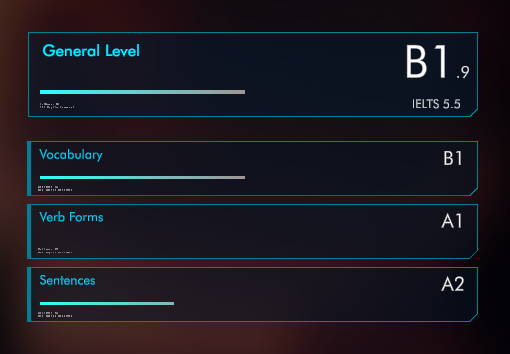
5. On the right side of your screen you can see a summary of your CEFR text feedback, for example:
3.How to use your CEFR feedback?
- write a section of text and check the overall score
- on the free version, you can only use 6 times a day (24 hours)
- you can improve vocabulary by checking the level of difficulty
- you can edit and improve your sentence structure
- you do not need to get a high score “result” every time. Please use as a guide to help you use high level words (topic terminology) and complex sentences
- any stage of your writing you can use this discourse analyzer
Course Goals
The goals for the main activities for 1.listening, 2.reading, 3.writing, and 4.speaking are:
1.Listening Goals:
1.Students can understand the main points of short discussions spoken by the teacher, and other students in group discussions in topic groups
2.Listening to media such as audio or video – YouTube (subtitles provided for support)
3.Can comprehension presentations conducted by other students
2.Reading Goals:
1.Students can read to understand the main points of English articles adapted for educational purposes,
2.Be able to search the internet and read information on topics.
3.Can read and understand simple problems and issues, and can understand processes or cycles
3.Writing Goals:
1.Students can understand, identify and write the main points of English
articles adapted for educational purposes,
2.Be able to write and paraphrase information on topics.
3.Can write to describe simple problems and issues, and other processes or
cycles
4a.Speaking Goals – Production
1.Students can talk in some detail about their experiences, ideas and points of view
2.Express opinions
3.Use topic based vocabulary, phrases and other target structures about class topics.
4b.Speaking Goals – Interaction
1.Students can express opinions and exchange topic based information in pairs or small groups
2.Can ask and respond to basic questions
Weekly Outline
Semester 2
Weekly Outline: This outline may change. Please check for updates!
- Introduction and Overview
- Topic Customs & Traditions: Reading and listening: Internet research
- Topic Customs & Traditions: Writing: short Paragraph Essays
- Topic Customs & Traditions: short 1 minute speeches
- Assessment
- Topic Health & Fitness: Reading and listening: Internet research
- Topic Health & Fitness: Writing: short Paragraph Essays
- Topic Health & Fitness: short 1 minute speeches
- Assessment
- Topic Discovery & Invention: Reading and listening: Internet research
- Topic Discovery & Invention: Writing: short Paragraph Essays
- Topic Discovery & Invention: short 1 minute speeches
- Assessment
- Final Project
- Final Project
- Test Week: Test
Semester 1
Weekly Outline: This outline may change. Please check for updates!
- Introduction and Overview
- Topic Animals: Reading and listening: Internet research
- Topic Animals: Writing: short Paragraph Essays
- Topic Animals: Speaking: short 1 minute speeches
- Assessment
- Topic The Environment: Reading and listening: Internet research
- Topic The Environment: Writing: short Paragraph Essays
- Topic The Environment: Speaking: short 1 minute speeches
- Assessment
- Topic Transport: Reading and listening: Internet research
- Topic Transport: Writing: short Paragraph Essays
- Topic Transport: Speaking: short 1 minute speeches
- Assessment
- Final Project
- Final Project
- Test Week:
Test
2025 – Course Information
Aim: This course aims to introduce Global English for learning about important topics and other worldviews, called ‘Global Education’.
What is Global education?
Global education is one that “incorporates learning about the cultures, geographies, histories, and current issues of all the world’s regions. It emphasizes the
interconnectedness and diversity of peoples and histories (Primary Source, 2022).
Therefore, the aim of this class is to develop student skills to;
a) engage students in topics as global peers,
b) show ways that students can take actionsas,
c) make students feel that they are part of citizens of the world.
Level: To introduce, support, and practice CEFR-J Can-Do A2.1 to B1.2 skills with emphasis on the B1.1 level to help students build and enhance needed core language skills.
Activities: conditions:
- Individual assignments / Project work
- Submissions: due A) in the next lesson, or B) online submissions
- Penalty: late submissions for projects is 2% (or 5 points) each day after the deadline (after 5pm).
Assessment Information: An assessment criteria or ‘Rubric’ will be used for student evaluation.
What is a educational assessment rubric?
A rubric is a check list of information for students to use when they prepare, evaluate and get assessed by the teacher when they submit work
Rubrics help students by:
1.”Focus their efforts on completing assignments in line with clearly set expectations.
2.Self and Peer-reflect on their learning, making informed changes to achieve the desired learning level” (UC Berkley, 2022)
Textbook and online eblog provided by thet teacher.
Class Target Goals (CEFR-J based) A2.1 ~ B1.2